
Aug. 13, 2026 - Full Show
8/13/2026 | 26m 46sVideo has Closed Captions
Watch the Aug. 13, 2026, full episode of "Chicago Tonight."
An update on the Chicago Bears stadium project. And what’s behind a recent string of water system malfunctions.
Problems playing video? | Closed Captioning Feedback
Problems playing video? | Closed Captioning Feedback
Chicago Tonight is a local public television program presented by WTTW
WTTW video streaming support provided by members and sponsors.
Aug. 13, 2026 - Full Show
8/13/2026 | 26m 46sVideo has Closed Captions
An update on the Chicago Bears stadium project. And what’s behind a recent string of water system malfunctions.
Problems playing video? | Closed Captioning Feedback
Where to Watch Chicago Tonight
Chicago Tonight is available to stream on pbs.org and the PBS app.

WTTW News Explains
In this Emmy Award-winning series, WTTW News tackles your questions — big and small — about life in the Chicago area. Our video animations guide you through local government, city history, public utilities and everything in between.Providing Support for PBS.org
Learn Moreabout PBS online sponsorship>> Hello and thanks for joining us on Chicago tonight.
I'm Brandis Friedman.
Here's what we're looking at.
>> We will make sure that we take our time to get this right.
>> The Chicago Bears say they're sold, focuses on Indiana for their stadium project.
Where does that leave Illinois?
>> Chicago, will that be passively?
By this new industry?
>> We explore what sustainable data center development could look like in Chicago.
How secure are Illinois's water systems from cyber attacks?
A local cybersecurity expert joins us.
>> A family legacy of Katherine in Joe's and it feels great.
Being a century of sweetness with Chicago's iconic rainbow Cone.
>> First off tonight, still no final decision about where the Chicago Bears Stadium will be built.
The team's president and CEO Kevin Warren updated reporters today on the status of the project saying they remain solely focused on Hammond, Indiana.
Warren says they've completed their due diligence on a site near the last Marsh golf course in Hammond, which he says remains viable, but have now identified a second site in the area near the Wolf Lake terminals.
As far as Illinois prospects, Warren says they've had occasional meetings with officials, but that there's no current offer on the table about whether they'd wait for lawmakers.
Are Illinois lawmakers fall veto session to make a decision?
>> I think it's prudent for us to move with pace based upon where we are.
These costs have gone up.
We've talked about it before you know, almost 150 million dollars a year.
reaching that point where we have to make a determination and decision the longer this goes, God goes on.
It creates complications.
>> Governor JB Pritzker says that it remains on the Bears to come to Illinois legislators and tell them what parameters are acceptable in any new bill.
He says that hasn't happened yet.
The Chicago Department of Public Health is not making any changes to recommendations for wind children receive vaccines.
This follows President Trump's executive order earlier this week calling for separate injections of the measles, mumps and rubella or MMR vaccine spacing out the shots whenever possible.
Cdph along with the Illinois Department of Public Health have both said they continue to endorse the existing childhood immunization schedules by the American Academy of Pediatrics protecting kids against 18 preventable diseases.
And for more beluga whales made their overnight move from a closed Marine Park in Canada to their new 3 million gallon home at the Shedd Aquarium.
That said, says the whales Caspian Pikachu, rain and secord range in age from 20 to 27 years old.
They were greeted by the familiar faces of the first for rescue blue.
Those who've been settling in behind the scenes since mid-July at the shed.
The animal care team there is watching the all-female pod.
24 7 to observe who they're spending time with how much they're eating and more other rescue blue cousins offense are to be sent to the Georgia Aquarium.
Seaworld locations and Spain.
City leaders try to keep data centers in check.
We hear their plans right after this.
>> Chicago tonight is made possible in part by the Alexander and John Nichols family.
The Pope Brothers Foundation.
And the support of these donors.
>> Mayor Brandon Johnson says it's time to take a hard look at data center development.
The rapidly evolving industry has become a flash point across the country with questions about public health, the environment and the economy as the build out charges ahead.
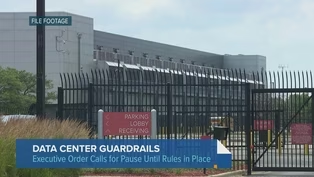
Many local leaders are racing to adapt, including in Chicago where the mayor this week signed an executive order calling for a pause on new data centers until new regulations are in place.
Here to discuss the city's role in responding to this developing industry are Angela Tovar commissioner of the city's Department of Environment and Chicago's chief sustainability Officer and Jared Patent, a project manager at the Department of Environment.
We also invited data center industry representatives who declined to join us.
But they did send a written statement which will share shortly.
Thanks to the 2 of you for joining us and welcome.
Thank you for having us.
So Jared, let's start with you.
Please.
What our existing data centers like in Chicago.
Yes, so we currently have about 39 data centers in the city of Chicago.
>> It's important to recognize that not all data centers are the same ones that we typically hear about on the news are very large artificial intelligence training campuses.
We don't currently have any of those in the city.
Most of our facilities tend to be what you call colocation facilities.
That's a data that's owned by one company.
And they went out some or all of their service space to other companies.
So might be multiple users of one building.
There facilities can range in size.
Some are just a few megawatts of energy, some or all the way up to what they call hyperscale facilities.
Have 100 or more megawatts.
Most of our data centers are located in the downtown South Loop is our biggest concentration or and utility corridors leading downtown.
What's the permitting process like to build one?
currently data centers are permitted by, right in most mean at all manufacturing districts, all commercial districts in most business districts.
If there is no additional plan development process unless they trigger that process for other reasons because of the size of the facility or proximity to more sensitive uses our data centers report.
Those recently released has recommendations for how we can change that to have a higher level of review.
It's okay.
>> Commissioner, what is the mayor's executive order?
Do so the executive order does a number of important things.
And primary importance is that it moves very quickly on this topic.
>> The Sustainable Data Center's report conveyed that there are a number of regulations that we have to put in place.
Our policies don't reflect what the modern data center looks like.
And so we have to move quickly to ensure that our regulations mirror what is required of a full environmental review related to data centers.
So it does a number of important things.
It directs the Department of Environment to look at our existing noise and air pollution control permits and to within 90 days make recommendations on how to improve those to think about those environmental impacts.
It also directs the Department of Planning and Development to look at a more enhanced to revive environmental review at the time of the plan development process.
So again, as Jared mentioned, if the data center is larger in scale or if it, you know, it could be the plan.
Development process can also be triggered by, you know, developing near the waterfront, for example, in those cases, the commissioner of the Department of Planning and Development.
Well, director cross departmental team to evaluate those impacts.
And then the other thing that the Iau does is that it creates a interdepartmental task force charged with shepherding this process through to realization I think one of the parts of this EO that got a lot of attention was the moratorium that the mayor called for.
How do you expect City Council to react to that?
>> Sure.
So I I think that council and the mayor have heard loud and clear from constituents.
>> Across the city and frankly, you know, other municipalities and across the nation as well, that there are deep concerns about how rapidly growing this industry is and what the potential environmental impacts are.
You know, we're hearing everything concerns about water consumption, concerns about energy use and energy intensity concerns about our utility Air quality noise, pollution.
And so if this is certainly something that we know that we have to address.
And so the mayor called for a temporary moratorium so that we can evaluate and put forth these regulations to City Council and we expect to be working hand in hand with City Council to get this moratorium passed.
Jared, the executive order.
It also comes on the heels.
You both mentioned a sustainable data Centers.
Working Group report released last month.
>> What did that report learn about the impacts of the current data centers?
>> Yeah.
So working group City Council established department working group 18 months ago for us to do a comprehensive review of what's happening with centers in Chicago.
And we identified a number of local and global impacts that come from data centers.
The global scale.
They use a lot of energy and that has concerns as impacts for energy affordability as well as climate change.
And our energy is not entirely clean.
Currently, they're also a lot of local impacts that come from data centers.
Most notably noise and air pollution.
So noise comes from cooling systems in from backup generators, air pollution comes from backup generators.
The report identified a number of recommendations.
Many of those are going to be proceed through the 2nd quarter for how to adjust.
That's okay.
>> So I do want to get to you know what we heard from the Data Center coalition.
That's the industry group.
Of course, they sent the following statement from Bread to eat his director of state government affairs for the Midwest.
He says, quote, the Data Center coalition and its members strive to be good actors where we operate, which is why we're hopeful this director from the mayor will separate those who are responsible, water and energy stewards from those who are not commissioner.
What your definition of responsible water and energy stewardship.
>> Sure.
I think you know, it's welcome that statement from from Brad.
And we certainly hope to have continued conversations with industry.
There's a lot of best practices that we can consider together.
I think a primary importance.
We need to drive more sustainable out comes the city has a wonderful precedents.
We've done that with are sustainable development policy and requiring, you know, large commercial buildings to abide by sustainable design standards.
That's why Chicago has so many wonderful lead buildings across across our city.
So we can certainly apply that same standard to all industry and to think about ways in which we can think of recycling water, right, reusing water so that we're not taking water from the front from our freshwater resources.
We can think be thinking about higher efficiency design.
We could be thinking about clean energy.
So if you're taking energy off the grid, utilizing creek, clean energy restoring that energy.
Back to the grid.
There's a lot of possibilities.
When we think about more sustainable systems and we can work and welcome that innovation as we think about next steps.
lastly, I want to share one last bit from that statement from Brett.
He's quote, data centers are net revenue generators that provide billions of dollars in economic investment.
>> Create thousands of highways, high wage jobs and help fund schools, transportation, public safety tax relief and other local priorities helping make life more affordable for Chicago.
And so obviously balance that has to be struck.
Commissioner, with regards to economic impact versus environmental impact and protection.
Sure.
And you heard the mayor say IPO signing that Chicago is open to business, but we aren't going to do that at the expense of our people.
>> And our communities and our water.
And that's an important value to lead an we can certainly work with industry to advance sustainable outcomes.
And we have to do that with understanding that these guardrails are important.
And that's the balance that we're trying to strike about.
30 seconds left.
Jerry Hauer, urban data centers, different from what you might see in other parts of the state.
Yeah.
So I mean, it really comes down to land use to local context.
When you're in a city, you don't have the ability to have a large vegetated buffer to cancel out sound, for example.
So, >> you know, when we develop our recommendations were really trying to be thoughtful about our local contacts.
We don't want to copy and paste what's worked in other areas because, you know, we're not a suburban community, Renata community from the East Coast to the West Coast.
We want to think really carefully about our own local contacts, focus on those noise concerns on those air pollution concerns.
This will have to leave a best of luck to both Angela Tovar Jared Patton, thank you for joining us.
Thank you so much.
Up next, concerns over the cyber security of our water supply.
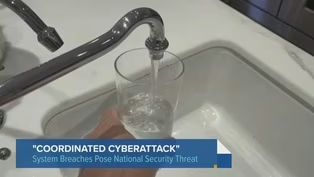
>> What appeared to be innocent malfunctions and municipal water systems could actually be something more serious at the end of July's several water systems from Minnesota to Georgia.
Southern went offline while officials restored them.
Cybersecurity experts now say the outages may have been linked to Iranian hacking groups raising larger questions about the security of America's critical resources.
Joining us now with more is Jacob Ron executive director of the Cyber Policy Initiative at the University of Chicago and former acting principal cyber director under the Biden administration.
Welcome back.
Thanks for joining Thanks, friends so take us back to the end of July.
What happened when the city's first realized something was wrong with their water systems?
Sure.
So the cyberattack attacked a PLC which is a device that helps control the it system.
And a commands to the physical system.
So the actual pumps and so on that that work make the water utility work, as you suggested, there's the assumption is that the Iranians were behind this attack and we think that this attack is not really about a specific or utility here or there.
It's really trying to send a message to the administration and the American people.
>> About where we're vulnerable.
And I think that what they're trying to do, Israeli show the administration that they can shut off the water to our military assets.
They can shut off the water to what may be the key economic driver in the country right now, which is our AI data centers.
And finally in the country that's deeply divided over the war are ready.
It it.
They're showing that they can undermine public trust government's ability to perform even the most basic life getting services like making sure the water turns on how to officials eventually realize are determined that they were dealing with cyber attack.
>> Well, once the this PLC device starts, you know, kind of malfunctioning and going screwy, people start looking at, well, how does this happened?
And when they looked into it, they see see this this thing done just randomly break somehow was a cyber attack.
It was done via technology came through the it system in the water utility.
And since the this particular device, this PLC devices pretty throughout the water.
Use utilities in America.
Once they saw the start popping up here and there and now it looks like we're up to over a dozen states that doesn't happen by just some random vice randomly breaking it.
It happens because of a coordinated cyberattack.
>> How are they gaining access to our water systems?
Well, they just warm their way through the Internet.
Unfortunately, most of the utilities that were successfully head where the smaller utilities that don't have budgets.
>> 2 higher big cyber companies are cyber professionals and make sure they have all the newest cyber defenses in place.
And so those were the low hanging fruit that the that presumably Iranian hackers we're able to attack.
And you said this.
I mean, you know, they did this sort of shot across the bow for now, right?
What are like the broader national security implications of the water system attack.
could be worse.
>> Oh, for sure.
And I think that's what the Iranians were trying to signal to the U.S.
It's I think it's no accident that this happened in the middle of negotiations and so on to show that, you know, they they have other cards to play.
What what's been the recent history of cyber attacks like these are these common have other countries experience something similar in the past?
There are in fact, there was a report today of cyber attack against water plant.
But the reason I actually want to getting involved in this issue was when I was at the White House was when the Chinese were pre positioning malware on our water utilities that support military assets around the country.
Presumably to U.S.
military know that if there's a conflict, assuming over Taiwan that they could shut off the water to a bunch of key military assets and unfortunately, nearly all of the military assets in the country are supported by civilian water, utilities and this is just water, right?
Like could there be similar implications are concerns other utilities, energy gas.
>> Yes, well, and in fact, the Iranians have been quite active and hitting other critical infrastructure.
So, for example.
>> Years ago when we launched a cyber attack against their nuclear program and it came to light.
They did a massive attack against our banking system and shut off online banking for weeks and weeks.
And by the way, we were able number, we were never able to stop it.
They just kind of got bored with it after a few weeks stop doing it on their own.
We also know they've been involved in our elections, not to our knowledge with actual hacking per se, but with MIS and disinformation, which is always coupled with different types of cyber attacks.
And then of course, we've seen the Russians and the Chinese act in similar ways and then ransomware groups have been attacking all types of critical infrastructure for years.
Now.
>> Is there anything that we can do that or that we should be doing to increase the security of our water systems?
>> Well, I absolutely we launched a program recently with the National Rural Water Association and a host of cyber providers around the country.
2 be able to deliver cyber security, too local water utilities around the country, its one of the big problems in the spaces that there's 150,000 water utilities, the country and delivering cyber to them.
This is a pretty intractable problem.
Many of these places we were talking to one in Alabama the other day where it's ran by one guy and he also runs the 4th of July parade for the town.
So the idea that these folks are going to be able to do their own cybersecurity, us, not going to work.
and to.
Well, that's why we launched this program.
>> One of the things you mentioned, but so many military installations are dependent on civilian water supply.
Should that be different?
Said our military installations have their own water supplies that even possible.
>> It would be possible it would cost an enormous amount of money.
And I think that while there are thousands of military installations who are supported by water, utilities.
Without big dog is budget, there's that would be a drop in the bucket to.
To support the cybersecurity.
Those utilities.
>> Has the administration been responding to these attacks?
Well, I think that >> there's been.
the president come out and of course and not agree that it's necessarily Iran.
But I think he's also the middle of an information war himself, obviously, and I think doesn't want to give them credence to been to be able to say that they were able to do this and also doesn't scare American public.
So I think they've been somewhat muted in this.
And I understand why I know that the cyber agency under Homeland Security has been doing a lot of outreach to local water utilities to try and tell them what they can do to to support our to deal with this problem.
But really at the end of the day, the federal government has to fund a solution for this.
And one of the reasons we launched this effort with the National Rural Water Association is because they've been funded by the federal government for about 50 years to provide technical assistance, albeit not got cyber to water utilities around the country with huge.
That's kind of an easy button for Congress to fund.
Okay.
Jacob, Ron, thank you so much.
Appreciate Thank you.
>> Up next, a sweet tradition celebrates hitting the century.
Mark.
It's been a Chicago staple for a century.
The original rainbow Cone started on the far South side in 1926.
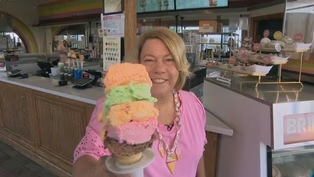
And now generations have grown up with the signature 5 flavors, Joanna Hernandez visited the original shop in Beverly to get the rather the slice.
>> For 100 years, one colorful Cohen has been a sweet tradition from one generation to the next.
And we're learning about its history.
Let's go inside.
>> One thing is kept customers coming back.
Those 5 iconic flavors.
>> Chocolate strawberry Palmer.
House pistachio reverts.
This is 100 sliced not scoops.
>> That's landsat program.
Parents, Joe and Katherine started the famous rainbow comb back in the 9 to 26.
So he created it.
>> And Catherine was the businesswoman that kept it going and counted all the nickels and dimes.
The original rainbow colocation along Western Avenue in Beverly.
>> Has come a long way since it first opened, it started off as a shock right across the street from where this location stands today.
Back in the 1920's, this part of the city looked very different.
It was considered the countryside in Joe SAP saw an opportunity to create something special and it was called Rainbow lot when it first opened, people came out to this area.
>> And it was remote.
So they called Rainbow Lodge and they served rainbow cone, Sundays and shakes and my grandmother would make a roast or a ham and have sandwiches for the day because there was nothing else out here for people.
>> And during those early years, the business was also home.
Linds grandparents lived in the parlor while her parents lived in a house behind the shop.
>> That's the original outside door because they got the first floor down and then they got the money to go out.
So this is where they live.
Like many people in Chicago, all these small little Chicago area.
This is as you see, people literally live, breathe work it's their life.
So they cave it in a French fry cart Collins or Newark Ko's.
We're starting it was either in a glass dish or you could get one slice of vanilla or one slice of chocolate or strawberry.
And that's where he got the idea to put one more one slice on home.
>> Even the tools her grandfather may tell part of the story.
So the chocolate always goes on.
The bottom.
Because it's easier to hold to the cone when looting took over the shop from her parents in 1986, she had a vision to bring her family's recipe and beyond Beverly That's my first year voting rainbow.
I went out and did festivals small ones.
this before Congo.
And while in was introducing Rainbow Cone to a new generation of Chicagoans, some customers had already been enjoying for This ice cream is delicious.
It always has been.
>> And even though I'm elect those intolerant, I still want frank Fabian says he was 10 years old when he tried this ice cream and was hooked people from all over come here because they've heard of it.
Now the original rainbow is moving into his 4th generation of ownership in 2018 bona companies took over the business.
We partner with the Bonavolonta family and they're going to continue it on for another.
>> 100, hopefully come my grandpa.
Would be so proud of that.
Take a bite of original rainbow cone and everything's going to be OK, maybe.
>> Thanks for 100 years.
Chicago shares.
>> For Chicago tonight, I'm joined on this.
>> Does look delicious.
And Beverly isn't the only place to get a rainbow cone.
They've got several other locations across Chicagoland.
And you can find the iconic flavors at many blown or restaurants, too.
And that's our show for this Thursday night.
Stay connected with our reporters like Patty Wet Lee and Joanna Hernandez.
As we bring you additional stories from across the Chicago area, you can follow us on Instagram at W T Tw Chicago and join us tomorrow night at 5.37, for the weekend review.
Now for all of us here at Chicago Brandis Friedman, thanks for watching.
Stay healthy and safe and have a good night.
>> Closed captioning is made possible by Robert a cliff and Clifford law offices, a personal injury law firm, working to preserve the
 New
NewCybersecurity Expert Talks Recent Water System Hacks
Video has Closed Captions
Several water systems from Minnesota to Georgia suddenly went offline in late July. (7m 18s)
 New
NewRainbow Cone Celebrates 100 Years
Video has Closed Captions
The Original Rainbow Cone started in 1926 on the Far South Side. (3m 58s)
 New
NewWhat Sustainable Data Center Development Could Look Like in Chicago
Video has Closed Captions
The rapidly evolving industry has become a flashpoint in communities across the country. (8m 32s)
Providing Support for PBS.org
Learn Moreabout PBS online sponsorship New Episode
- News and Public Affairs

Top journalists deliver compelling original analysis of the hour's headlines.

- News and Public Affairs

Today's top journalists discuss Washington's current political events and public affairs.




 New Episode
 New Episode


Support for PBS provided by:
Chicago Tonight is a local public television program presented by WTTW
WTTW video streaming support provided by members and sponsors.