
The Physics of the Multiverse
Clip: Season 45 | 4m 12sVideo has Closed Captions
A multiverse could explain why our universe is fine-tuned for life.
A multiverse could explain why our universe is fine-tuned for life.
Problems playing video? | Closed Captioning Feedback
Problems playing video? | Closed Captioning Feedback
National Corporate funding for NOVA is provided by Carlisle Companies. Major funding for NOVA is provided by the NOVA Science Trust and PBS viewers.
Support provided by:


The Physics of the Multiverse
Clip: Season 45 | 4m 12sVideo has Closed Captions
A multiverse could explain why our universe is fine-tuned for life.
Problems playing video? | Closed Captioning Feedback
Where to Watch NOVA
NOVA is available to stream on pbs.org and the PBS app.
NOVA Labs
NOVA Labs is a free digital platform that engages teens and lifelong learners in games and interactives that foster authentic scientific exploration. Participants take part in real-world investigations by visualizing, analyzing, and playing with the same data that scientists use.Providing Support for PBS.org
Learn Moreabout PBS online sponsorshipGreg Kestin: There seems to be a nearly perfect balance in the universe.
Seriously.
There's a force pulling everything together-gravity-and a kind of force pushing everything apart-dark energy.
If, say, dark energy were even a little bit stronger, then there'd be no stars, there'd be no atoms, there'd be no life at all.
The most baffling number in all of physics is the value of the cosmological constant, denoted Lambda.
It's the measured density of dark energy, and it controls how fast the expansion of the universe speeds up or slows down.
If Lambda were a positive number, like 1 or 56 or 576 trillion, then the universe's expansion would have sped up so fast that all the particles in the universe would've exploded away from each other in the first second of the universe.
If Lambda were a negative number, like -0.2 or -7 or -576 billion, then its expansion would have slowed down and everything in the universe would have collapsed back in on itself.
But if Lambda were zero, then the universe wouldn't have exploded outward, it wouldn't have collapsed in on itself; it would just expand at a constant rate and look very much like it does today.
Now, here's the baffling thing: In 1998, astronomers discovered that Lambda isn't zero.
It's actually 1.1x10^-52.
So, why that number?
It seems pretty random.
Even to physicists it seems random.
But, coincidentally, it's so close to zero that that explosion outward of the universe is slow enough for galaxies, stars, planets, and life to exist.
And the probability of luckily getting a number like that, just by chance, well, let's just say, it's less likely than you winning the lottery.
This isn't the only number in physics that seems a little too perfect.
The strength of the strong nuclear force-tweak that a little bit and chemistry's just gone.
You don't have different kinds of elements.
There's no nuclear fusion in stars, there's no oxygen to breathe, there's no carbon so life wouldn't have existed in the first place.
The masses of the fundamental particles-tweak that and we would all be so massive that we would just turn into black holes.
So, why do the fundamental laws of nature seem perfectly tuned for stars, planets, atoms, and life?
Greg Kestin: Consider for a second the possibility that we live in one of many-maybe infinite-universes.
There could be a universe where everything stretched away from each other so quickly in the first second of the universe that there's no stars or galaxies.
There could be a universe where everything is black holes.
And we couldn't exist in those universes.
But there's at least one universe that has fundamental constants perfect for stars, galaxies, planets, atoms, and life.
So maybe we live in just one universe that can support us.
Greg Kestin: Some physicists are trying to "see past the edge."
They're scanning the sky for imprints in the thin radiation that fills the entire universe.
If they find them, these imprints, or "bruises," might be places where our universe bounced against another universe.
Let me know in the comments.
Jupiter's Latest Moon Discovery
Clip: S45 | 1m 20s | As if 67 moons weren’t enough, scientists discovered 12 new ones orbiting the planet. (1m 20s)
Video has Closed Captions
Clip: S45 | 2m 48s | Take a look back at some of the biggest science stories of 2018. (2m 48s)
Fireproofing Our Future through Better Design
Video has Closed Captions
Clip: S45 | 3m 37s | Before a wildfire ever starts, there are ways to make homes and buildings safer. (3m 37s)
Turn to Science for Great Thanksgiving Stuffing
Video has Closed Captions
Clip: S45 | 3m 24s | Learn the secret to making delicious stuffing that's not gummy. (3m 24s)
Winter Is Coming… And So Is Seasonal Depression
Video has Closed Captions
Clip: S45 | 3m 4s | As the days shorten, our internal clocks have to recalibrate. But that's hard for some. (3m 4s)
Modern Politics Activates the Brain's Ancient Wiring
Video has Closed Captions
Clip: S45 | 3m 9s | How does your brain process political ideas? (3m 9s)
Video has Closed Captions
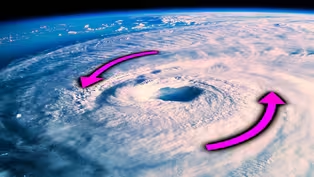
Clip: S45 | 4m 18s | The spinning of the Earth means we don't always see straight paths as straight. (4m 18s)

Video has Closed Captions
Clip: S45 | 5m 33s | Antonio Paris translates how to survive on other planets into surviving after Maria. (5m 33s)
Video has Closed Captions
Clip: S45 | 3m 58s | After Hurricane Maria, the Arecibo Observatory staff worked to rebuild its facility. (3m 58s)
Macaque Monkeys Adapt After Hurricane Maria
Video has Closed Captions
Clip: S45 | 4m 44s | Researchers investigate whether 1800 macaques may have been changed by Hurricane Maria. (4m 44s)

Distributed Energy in Puerto Rico
Video has Closed Captions
Clip: S45 | 7m 15s | Puerto Ricans are innovating to find new energy solutions after Hurricane Maria. (7m 15s)
Hawaii’s Kilauea Volcano Erupts
Clip: S45 | 1m 14s | New fissures are devastating neighborhoods on Hawaii’s Big Island. (1m 14s)
Video has Closed Captions
Clip: S45 | 3m 48s | In different but similar ways, both your brain and the laws of physics can slow down time. (3m 48s)
Video has Closed Captions
Clip: S45 | 6m 9s | Remembering John Pilley, the owner and trainer of Chaser the Border Collie. (6m 9s)
Video has Closed Captions
Clip: S45 | 2m 18s | Scientists found a large body of liquid water beneath the southern ice caps of Mars. (2m 18s)
Video has Closed Captions
Clip: S45 | 1m 9s | NASA launched a new spacecraft to study the Sun like never before. (1m 9s)

Video has Closed Captions
Clip: S45 | 4m 21s | Explore the science of grilling and how it could affect your health. (4m 21s)

Clip: S45 | 35s | What the Physics?! is about the physics in you, of you, and around you. (35s)
Physics Is Erasing Your Memory
Video has Closed Captions
Clip: S45 | 4m 53s | Thanks to physics, no memory can last forever. (4m 53s)

Separation and Children’s Brains
Video has Closed Captions
Clip: S45 | 3m 19s | Even brief separations can impair the brain development of a young child or infant. (3m 19s)
Video has Closed Captions
Clip: S45 | 3m 27s | It’s pretty different from the atom you saw in your textbooks. (3m 27s)
Clip: S45 | 2m 38s | Hawaii’s Kilauea and Guatemala’s Fuego volcanic eruptions have been remarkably destructive (2m 38s)
Net Neutrality’s End and Science
Video has Closed Captions
Clip: S45 | 3m 3s | Depending on your perspective, the repeal of net neutrality could help or hurt science. (3m 3s)
What Does Dark Energy Look Like?
Video has Closed Captions
Clip: S45 | 4m 16s | The mysterious substance ripping our universe apart. (4m 16s)

Video has Closed Captions
Clip: S45 | 3m 7s | How the laws of physics forbid perfect cloning. (3m 7s)

Clip: S45 | 2m 57s | How do we program moral decision-making into autonomous vehicles? (2m 57s)

Black Hole Information Paradox
Video has Closed Captions
Clip: S45 | 3m 56s | Do black holes delete information forever? Or could information somehow escape them? (3m 56s)
Choose Your Own Adventure into a Black Hole
Video has Closed Captions
Clip: S45 | 37s | What would it be like to fall into a black hole? Choose your own adventure to find out! (37s)
Clip: S45 | 2m 15s | There are worlds beyond our own. A new explorer just left Earth to hunt for them. (2m 15s)
Clip: S45 | 2m 16s | April Fool's! We weigh in on the serious science behind... whoopee cushions. (2m 16s)

Video has Closed Captions
Clip: S45 | 2m 9s | Guess which of these five unbelievable facts are real physics. (2m 9s)

Video has Closed Captions
Clip: S45 | 2m 48s | Stephen Hawking had a way of bringing the most cosmic ideas down to Earth. (2m 48s)

Saving Snowy Owls from Airplanes
Clip: S45 | 3m 25s | When snowy owls land at Logan Airport, Norman Smith gives the birds a one-way flight out. (3m 25s)
 Now Playing
Video has Closed Captions
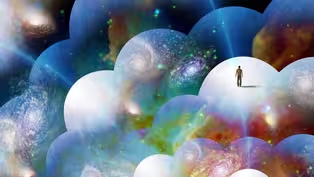
Clip: S45 | 4m 12s | A multiverse could explain why our universe is fine-tuned for life. (4m 12s)
What Is Dark Matter? A New Clue!
Video has Closed Captions
Clip: S45 | 3m 38s | A signal from the dawn of the universe may hold surprising clues about dark matter. (3m 38s)
Clip: S45 | 56s | In honor of Black History Month, we celebrate these black scientists. (56s)

Curling, A Great Physics Mystery
Clip: S45 | 4m 32s | To physicists, curling presents the most puzzling conundrum in the Olympic Games. (4m 32s)
Video has Closed Captions
Clip: S45 | 4m 41s | Sometimes the biggest puzzle in physics seems like the worst relationship in the universe. (4m 41s)
Clip: S45 | 3m 44s | From necking giraffes to monogamous parasites, creatures couple up in unexpected ways. (3m 44s)

Video has Closed Captions
Clip: S45 | 7m 37s | "What The Physics?!" host, Greg Kestin, answers questions from you, our viewers. (7m 37s)
Clip: S45 | 3m 17s | Here's how a blockchain tracks and theoretically secures the movement of digital currency. (3m 17s)

Clip: S45 | 2m 14s | Bitcoin and other cryoptocurrencies—the future of money or hype? Here's what they are. (2m 14s)
Seeing Quantum with the Naked Eye
Video has Closed Captions
Clip: S45 | 3m 55s | Simply squinting at a lamp highlights the quantum nature of light. (3m 55s)
Can Tech Save Players’ Brains?
Clip: S45 | 2m 49s | Football is a full-contact sport, but can a high tech mouth guard help save players’ brain (2m 49s)
Clip: S45 | 1m 34s | How might science help avoid tragic deaths caused by landslides? (1m 34s)
Clip: S45 | 2m 14s | The flu vaccine changes from year to year and its efficacy varies. Here’s why. (2m 14s)
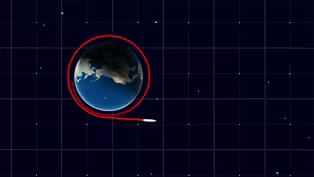
How NASA’s Apollo 8 Left Earth’s Orbit
Clip: S45 Ep18 | 2m 24s | Apollo 8 was the first in the world to head to the moon using trans-lunar injection. (2m 24s)
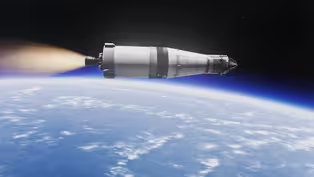
Five Apollo 8 Technological Breakthroughs
Clip: S45 Ep18 | 2m 32s | The Apollo 8 spacecraft—and its mission—marked a revolution in spaceflight. (2m 32s)
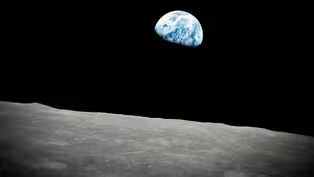
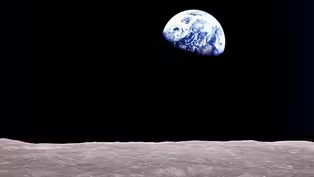
Capturing "Earthrise" from Apollo 8
Video has Closed Captions
Clip: S45 Ep18 | 1m 45s | Many consider “Earthrise,” to be one of the most important photos of the 20th century. (1m 45s)
Apollo's Daring Mission Sneak Peek
Video has Closed Captions
Preview: S45 Ep18 | 1m 17s | Apollo astronauts and engineers tell the story of the first manned mission to the moon. (1m 17s)
Providing Support for PBS.org
Learn Moreabout PBS online sponsorship New Episode
- Science and Nature

Capturing the splendor of the natural world, from the African plains to the Antarctic ice.

 New Episode









Support for PBS provided by:
National Corporate funding for NOVA is provided by Carlisle Companies. Major funding for NOVA is provided by the NOVA Science Trust and PBS viewers.