
The mental health toll of gun violence in America
Clip: 4/28/2026 | 6m 30sVideo has Closed Captions
The mental health toll and lifelong consequences of gun violence in America
Gun violence continues to impact communities across the country daily. Many don't make the news, but create lifelong consequences for victims, their families and even entire neighborhoods. The normalization of shootings has created a persistent public health crisis. William Brangham discussed the toll with Dr. Emmy Betz, director of the Firearm Injury Prevention Initiative.
Problems playing video? | Closed Captioning Feedback
Problems playing video? | Closed Captioning Feedback
Major corporate funding for the PBS News Hour is provided by BDO, BNSF, Consumer Cellular, American Cruise Lines, and Raymond James. Funding for the PBS NewsHour Weekend is provided by...
The mental health toll of gun violence in America
Clip: 4/28/2026 | 6m 30sVideo has Closed Captions
Gun violence continues to impact communities across the country daily. Many don't make the news, but create lifelong consequences for victims, their families and even entire neighborhoods. The normalization of shootings has created a persistent public health crisis. William Brangham discussed the toll with Dr. Emmy Betz, director of the Firearm Injury Prevention Initiative.
Problems playing video? | Closed Captioning Feedback
How to Watch PBS News Hour
PBS News Hour is available to stream on pbs.org and the free PBS App, available on iPhone, Apple TV, Android TV, Android smartphones, Amazon Fire TV, Amazon Fire Tablet, Roku, Samsung Smart TV, LG TV, and Vizio.
Providing Support for PBS.org
Learn Moreabout PBS online sponsorshipAMNA NAWAZ: Gun violence continues to impact# communities across the country on a daily basis,## often in ways that don't make the news, but# create lifelong consequences for victims,## their families, even entire neighborhoods.
The normalization of shootings,# fueled in part by easy access to guns,## has created a persistent public health crisis.
William Brangham tells us more.
WILLIAM BRANGHAM: Think of the most# recent shootings that made national news,## the foiled attack on President Trump this# weekend, for sure, but what about the horrible## murder of eight children two Sundays ago in# Louisiana?
That received far less attention.
Or what about the mass shooting# in Indiana three days ago,## where nine people were shot?
According to the Gun# Violence Archive, while shootings are going down,## in just the last 72 hours, there have# been over 175 different shootings in## this country where someone was shot or# killed.
That is just three days' worth.
For more on how we reckon with this ongoing# toll, we are joined again by Dr.
Emmy Betz.## She's an E.R.
doctor and associate dean for# centers and institutes at the University of## Colorado Anschutz School of Medicine and director# of the Firearm Injury Prevention Initiative.
Dr.
Betz, so nice to see you again.
Do you think we have just gotten desensitized# to this ongoing toll of gun violence?
DR.
EMMY BETZ, Director, Firearm Injury# Prevention Initiative: I think, to some## extent we have, I think especially#.. we're all dealing with and the# chaotic world we're living in.
But I think it's really important that# we not settle for this as a new normal.## It doesn't have to be this way,# and I think it's important that## we keep having these conversations,# so that we can find a better future.
WILLIAM BRANGHAM: And I know you think# it's important to remind people that,## as I mentioned, shootings, while# still horrendous, are going down.
I think it's important we talk about that# gun violence as a problem is big and complex,## and it's not just mass shootings.# We know the daily toll of violence,## the majority of gun deaths in this country are# from suicide.
That's been a persistent problem,## and we're not seeing improvement,# despite a lot of promising work.
But where we are seeing improvement# is in homicides.
So, gun murders## are at historic lows in terms of# decreases in rates and numbers,## for the past three years, and that's# really something to celebrate.
WILLIAM BRANGHAM: Do you have a sense,## do other researchers have a sense# as to wh.. DR.
EMMY BETZ: So there's not a single# answer, and I think this is one of the## things that's both complicated about these# discussions, but also should bring us hope.
There's not going to be one perfect fix# to this problem.
There's not one law,## there's not one policing approach or one# intervention we need to put in place.
It## takes a lot of pieces working together.# So we have seen a decrease in murder rates## because of things like wraparound and# comprehensive intervention programs to## get at those upstream risk factors related to# socioeconomic stress, job stress, et cetera.
We're seeing differences in policing approaches.# All of these things that can work together,## even things like neighborhood design,# better lighting, better green spaces, can## have an impact in helping reduce violence in the# community, and we see that murder rate go down.
We are, though, still having persistent# problems related to violence within homes.## So I mentioned suicide, but we also really# need to be talking about domestic violence,## and domestic violence and suicide are often# closely linked, as we have seen in recent cases.
WILLIAM BRANGHAM: As you mentioned, we often,## in the media, focus on big shootings, the# ones with the really grim death tolls.
But that often overlooks the much larger# number of people who survive shootings,## either shootings of themselves or of# their loved ones, and who then often## have to reckon with that trauma for# years, maybe the rest of their lives.
DR.
EMMY BETZ: No, it's very true.
We# talk a lot about the deaths, because,## in some ways, those are easier to# count.
But we do need to recognize## the bigger toll that it's having on all# of us as survivors and as a society where## we see people changing behavior because# of fear of mass shootings and so forth.
And we need to recognize, at the individual# level, people can have complex and differing## responses after trauma.
Somebody might seem fine# right away and then have symptoms develop later.
And it's important to know, if you# have been through any kind of trauma,## if you have been in a mass shooting situation,# or if you have lost a loved one to violence,## that there are effective and evidence-based# treatments out there, and there's help available.
WILLIAM BRANGHAM: Do you think that, in part, we# don't talk about suicides and domestic violence## in their relation to gun violence because, in# some ways, those are considered taboo topics,## things that are just for, that's someone's# internal problem, that's not a national problem?
DR.
EMMY BETZ: I think so.# And I think it's something,## we need to continue to fight against that stigma.
I think, during the COVID pandemic, we saw# a lot of increased awareness about how sort## of the roller coaster of life brings ups and# downs for all of us.
And when we think about## suicide and firearm suicide, in particular, we# know it's that when someone's in a bad moment.
So maybe it's mental illness, but maybe it's# also losing a job, getting divorced, kind of## having all of those bad things in life hit you at# once.
If a lethal method like a gun is available,## the person is much less likely to survive.# So it's not that the gun causes the suicide,## but it's that, in that moment, it's less safe for# someone if they're in an environment with a gun.
It's very much like a designated driver at the# bar who helps a friend get home while they're## impaired.
In the same way, we need to be thinking# about how do we reduce access to firearms for## people going through difficult times who might# be at suicide risk, elevated risk of suicide,## but who might also -- maybe they're dealing# with anger issues and going through bad divorce## and might be at risk of hurting their# partner or their family, for example?
So that's where, again, it's not# that the gun is causing the problem,## but it's a key factor that# leads to fatal outcomes.
WILLIAM BRANGHAM: Dr.
Emmy Betz at the University# of Colorado Anschutz School of Medicine,## always great to hear from you.
Thank you so much.
DR.
EMMY BETZ: Thank you so much.
 New
NewComey indicted over social media post DOJ says crossed line
Video has Closed Captions
James Comey indicted over social media post Trump's DOJ says crossed a line (4m)
 New
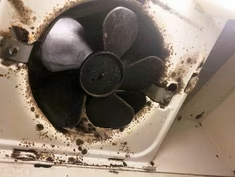
NewFamilies sound alarm on toxic mold in military housing
Video has Closed Captions
Families sound alarm on toxic mold in military housing (10m 1s)
 New
NewFCC threatens ABC as Trumps call for Kimmel's firing
Video has Closed Captions
FCC threatens ABC's licenses as Trumps call for Kimmel's firing (6m 3s)
 New
NewHow the UAE's departure from OPEC could impact oil markets
Video has Closed Captions
How the UAE's departure from OPEC could impact oil markets (6m 41s)
 New
NewKing Charles calls for unity in rare address to Congress
Video has Closed Captions
King Charles calls for unity in rare royal address to Congress (5m 55s)
 New
NewNews Wrap: Federal agents search Minnesota childcare centers
Video has Closed Captions
News Wrap: Federal agents search Minnesota childcare centers (4m 43s)
 New
NewTessa Thompson and Adrien Brody on new play 'The Fear of 13'
Video has Closed Captions
Tessa Thompson and Adrien Brody on Broadway debuts in 'The Fear of 13' (7m 33s)
Providing Support for PBS.org
Learn Moreabout PBS online sponsorship
- News and Public Affairs

FRONTLINE is investigative journalism that questions, explains and changes our world.

- News and Public Affairs

Each week, explore science, health, and technology headlines with leading experts.












Support for PBS provided by:
Major corporate funding for the PBS News Hour is provided by BDO, BNSF, Consumer Cellular, American Cruise Lines, and Raymond James. Funding for the PBS NewsHour Weekend is provided by...