
Illinois House Speaker on State Budget, Bears Stadium Plan
Clip: 6/2/2026 | 12m 33sVideo has Closed Captions
Emanuel "Chris" Welch discusses the bills that passed before the House adjourned for the summer.
It was well past 4 a.m. Monday when the state House adjourned for the summer. The budget had been balanced, and a flurry of bills were sent to the governor's desk. Emanuel "Chris" Welch discusses what passed and what had to wait.
Problems playing video? | Closed Captioning Feedback
Problems playing video? | Closed Captioning Feedback
Chicago Tonight is a local public television program presented by WTTW
WTTW video streaming support provided by members and sponsors.
Illinois House Speaker on State Budget, Bears Stadium Plan
Clip: 6/2/2026 | 12m 33sVideo has Closed Captions
It was well past 4 a.m. Monday when the state House adjourned for the summer. The budget had been balanced, and a flurry of bills were sent to the governor's desk. Emanuel "Chris" Welch discusses what passed and what had to wait.
Problems playing video? | Closed Captioning Feedback
How to Watch Chicago Tonight
Chicago Tonight is available to stream on pbs.org and the free PBS App, available on iPhone, Apple TV, Android TV, Android smartphones, Amazon Fire TV, Amazon Fire Tablet, Roku, Samsung Smart TV, LG TV, and Vizio.

WTTW News Explains
In this Emmy Award-winning series, WTTW News tackles your questions — big and small — about life in the Chicago area. Our video animations guide you through local government, city history, public utilities and everything in between.Providing Support for PBS.org
Learn Moreabout PBS online sponsorship>> It was well past 04:00AM Monday morning when the Illinois General Assembly adjourned for the summer.
By then the budget has been balanced and a flurry of bills sent to the governor's desk.
But a busy finished to the spring session left some of the biggest decisions in some cases.
The decision to wait until the very end here to share his perspective on the session is the representative who presided over at all speaker of the Illinois House Emanuel, Chris Welch.
Welcome back.
Thanks for joining My pleasure be here.
So the Senate passed a new bill with incentives for the Bears to have to talk about the for the Bear Stadium Senate to the House sometime around 3.30, Monday morning.
Were your first thoughts at 03:30AM, in the morning when that bill arrived at the House?
Well, certainly.
>> My first thought was we don't have time to consider that in the House.
We have processes in place that we've been very consistent with some time become speaker.
And that involves getting a lot of stakeholder input.
The biggest stakeholders to me or my members and we caucus on things.
We survey the caucus.
We get a lot of input from our members and we had no time look at the bill.
Read the bill.
Let alone going to caucus and talk about it at 3.30, in the morning.
And so just we ran out of time.
>> By 03:30AM, in the morning.
You all are technically past year.
Your midnight deadline.
Well, technically.
But when you have a super majority and you know that the votes are there for other things, you can continue working.
>> in this regard, it would only 60 votes.
But we didn't.
We believe in have 60 vote.
And that's the byproduct of people not having information and you got to make sure they have the information answers to their questions.
>> But the Senate chose to speed up that new bill rather than risk losing the Bears to Indiana House shows the opposite.
>> You know, our processes are very different.
And as leader of chamber, I understand what the Senate president was going through.
You have to listen to your membership to be responsive to your members.
All reports in the House was in order to get someone to vote for something that impacts the mayor's.
That also has to impact other areas of the state order to get 60 people from across the state to vote on a bill in the House.
It really nice to impact the entire state and the bill that I've read that came more from the Senate so far does not do that.
And it's just a different approach.
And apparently our didn't stand a chance in the Senate.
And so we're going to keep our conversations going over the summer here and hopefully we can.
We can find something that works for the Bears.
What into that?
You know, the House first passed that mega projects bill back in April.
>> Why didn't go?
She ation still end up coming down to the last minute.
That's the legislative process that sausage making and Springfield, people understand lines and sometimes the deadlines.
>> Are the reason why things actually get in this case.
It's why didn't get done.
We ran out of time.
In the House from our perspective, really need to take your time to get it right rather than go fast and get us law.
complex issues like this.
It's really important that you don't rush something.
This is not easy by any chance.
you know, we passed a lot of things the other night that has been around for 2 years complex legislation takes time.
>> Are you planning or is there any chance that your plan to call a special session in the summer to discuss stadium You know, they're still plans to call a special session.
>> We are back in November.
And then again in January for a lame duck session.
What I think is really important is to keep the conversations going.
People know that you're working honestly, if we can reach an agreement between the House, the Senate, all of the stakeholders that are involved you know, that's what's really important right now is to keep doing the work and we're committed to doing that.
Bears have said the plan to keep their own timeline.
Do you are you have any concerns that that timeline at the end of their timeline?
>> They decide to go to India.
Well, obviously, you know, I can't dictate what the Bears timeline is.
All I can do is commit to them that and show them by my actions that were willing to continue to work.
>> I already I left Springfield meetings on my schedule that involved the Bears and we're going to keep those meetings have those conversations and do everything we can to get to that agreement.
>> Ok, so also the budget this year.
55.9 billion dollars.
Almost 56 billion have federal funding concerns play into this year's negotiation?
You know?
>> It really made it the most complicated.
But you that I had to work on my 6 years as speaker and truly the the HR one bill that passed last summer.
The big, Bad ugly Bill just had negative impacts on our budget all across aisles.
And so we had to figure out a way to pass a fiscally responsible budget that help, you know, working class families across the state.
And that's a difficult task to do this year and what we got it with pastor balanced budget since Governor Pritzker has been governor 6 inside been speaker.
And it really is a a fiscally responsible budget that takes care of people.
>> The spending bill, though, again, not pass until those final hours of the legislative session, which in my experience, has also been fairly typical.
What were the sticking points this go around?
>> Well, if you look at the bill that passed the other night, we found a budget bill the first week in May, the bill that passed tonight probably 2% different.
3% different from what we filed that entire budget has been out there for over a month.
What comes down to is I have to listen to my members who have things that it's important to them, that they got go back home and explain.
president has members what last minute things.
That's part of the process and literally the budget that we passed when we pass.
It is very different from what was introduced in February filed in May.
And what ultimately passed.
>> However, the discussions like when deciding where to look for new sources of revenue.
>> Well, you know, one of the things is our progressive caucus is in both chambers were very insistent those who can pay more should pay more looking at corporations looking at the rich.
And I got to tell they had some some winds in this budget cycle.
You know, we close some corporate loopholes, decouple it from couple loopholes.
We've pass taxes on social media platforms.
Digital ad attacks prediction markets, fantasy sports cryptocurrency.
All these new things that call for some some taxation.
that's what helped us close the budget.
Nothing on regular everyday people.
We have not done that.
And I think that was very important.
The progressive caucus is in both chambers.
>> Well, raising income tax on higher and higher earners continue to be a priority in the future.
You said that, you know, there were some winds for the progressives who are calling for that.
But will there be more later on?
Tell you, Brandis taxing the rich is very important to me.
Those pay more, who can pay more should pay more.
>> To those who much is given much is required and I very hard for surcharge tax on millionaires to on our November ballot came up just short in the House.
The Senate president and agreed to talking the summer and find ways to come an agreement on that language that we can probably look at in 2028.
But honestly, we do need some structural reform and those who can pay more should pay more.
>> House Republicans pointed to the scheduling of the House and Senate sessions as one of the why they think many decisions were left until the last day.
Here's House Republican leader Tony Macomb be speaking on Sunday.
>> As you started the the calendar year this year, you could tell right away by the difference of the calendar.
>> That the Senate and House Democrats were not communicating with one another.
And you're still seeing that today.
>> was there are adequate collaboration between the House and the Senate are in session.
I think we had excellent cooperation and coordination.
>> As evidence by yet another balance budget.
You know, passage of massive cannabis hemp regulation AI regulation, a junk fee ban act.
Things that have been in the works for over 2 years.
Now.
And that's because of the coronation of the chambers.
Our chambers are very different line is double the size of the Senate.
The second year of a GA involves election here.
There's a lot of needs of members to be back home in their districts.
Our our needs are different from the Senate needs.
And so one sitting down to the calendar that had to come into play the differences in the 2 chambers in the needs of members to be back home.
And that's what people saw.
But the false narrative that that created was that there was no coronation, the substantive things that we got done shows that there was indeed a lot of coordination in the same vein.
Was there enough coordination, a collaboration with members across the aisle, GOP?
>> I think we've gotten better every year since I've been speaker.
You know, leader Macomb be said earlier on the radio show that.
>> You know, she enjoyed the conversations with me, her budget 2 years with my budget.
Here's there's a lot of coordination.
Are we going to agree?
We're going to disagree probably more than we agree because of the differences in the parties.
But, you know, we can do better.
We can always do better.
And I'm committed to that.
>> You know the evidence base funding program for K through 12 schools that increase this year by 350 Million.
But the state Board of Education estimates it would take nearly 10 times that amount to bring all school districts up to 90% of their adequacy target should K through 12 funding have been a higher priority this year.
>> If you look at the budget that we passed the other day, the single biggest thing that was prioritize was K through 12 funding.
We put in 350 million new dollars since I've been speaker.
We're close to 2 billion new dollars for K through 12 education.
Are we at the level?
We should be a no.
But that's going to take that new revenue stream that we need.
And that's what I think we need the structural tax change.
That's why I think a on millionaires will be very important.
Those are dollars that can help us properly fund evidence based funding formula.
>> Are there any concerns that, you know, this funding formula might fail with that is not implemented the way research says it should, which is, of course, with the funding adequate to educate students on the data shows is working.
It's been working since we passed in 2017 and it's been fully implemented.
>> It's working the way it was intended.
It would probably work better and faster if we were able to fully fund it.
But the problem is, is the budget has pressures all across silos and there's only a finite resources if we can find additional resources, would we're committed to continue do that.
Work on.
We certainly will do that and funding fully funding that evidence base formula is extremely important to me.
>> The AI regulations passed this session recognize to some of the strongest in the country passed the House unanimously at the same time, the tech companies OpenAI and Tropic also supported these regulations.
So I'm kind of wondering if the AI companies are supported.
Does that indicate that your legislation, new regulations could have been stiffer?
>> You know, got to tell you know, you have to have those folks at the table, their stakeholders, you know, they know their industries, but they also know that they need regulation our regulation is tough for the New York and California.
They fought against some of the things that we put in our bill because it was tough for the New York and California, but we got it done.
It was very important we lead the way on that and they knew it was going to happen.
And so they they decide to participate in the process rather than not participate in the process.
And that was welcome.
>> few seconds left speaker, what are your priorities for the caucus moving into the summer?
Well, I can tell you, number one, I want them in their districts knocking on doors.
Let the folks know what we did and why we did it.
There's a of things that they go home read about this book.
This budget focused on affordability.
We brought costs down and so many areas we've we froze the gas tax.
We have a school holiday on supplies for the upcoming school season.
We we expanded the school lunch program.
There's a lot of things that we had to do in response to what's going on in Washington.
We created the first of its kind fresh program help those that Trump kicked off of the SNAP program.
That's in this budget.
There's a lot of things they need to go out there and have those town hall meetings and knock on doors.
So let the people know what actually went on.
All right.
Voters can expect to see the
 New
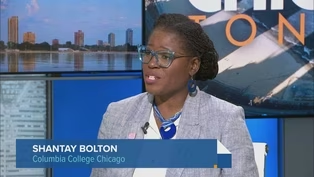
NewColumbia College's New President on the Institution's Future
Video has Closed Captions
Shantay Bolton is the first woman of color to lead the institution. (7m 15s)
Providing Support for PBS.org
Learn Moreabout PBS online sponsorship
- News and Public Affairs

Top journalists deliver compelling original analysis of the hour's headlines.

- News and Public Affairs

Today's top journalists discuss Washington's current political events and public affairs.










 New Season
Support for PBS provided by:
Chicago Tonight is a local public television program presented by WTTW
WTTW video streaming support provided by members and sponsors.