Here and Now
Jason Stein on Budget Headwinds Facing Milwaukee
Clip: Season 2400 Episode 2449 | 5m 18sVideo has Closed Captions
Jason Stein on a $50 million dollar deficit in one year in the Milwaukee County budget.
Wisconsin Policy Forum President Jason Stein discusses the budget headwinds facing Milwaukee — a $50 million dollar deficit in one year and $170 million in five years — including why shared revenue won’t fill the hole and what the county might cut.
Problems playing video? | Closed Captioning Feedback
Problems playing video? | Closed Captioning Feedback
Here and Now is a local public television program presented by PBS Wisconsin
Here and Now
Jason Stein on Budget Headwinds Facing Milwaukee
Clip: Season 2400 Episode 2449 | 5m 18sVideo has Closed Captions
Wisconsin Policy Forum President Jason Stein discusses the budget headwinds facing Milwaukee — a $50 million dollar deficit in one year and $170 million in five years — including why shared revenue won’t fill the hole and what the county might cut.
Problems playing video? | Closed Captioning Feedback
Where to Watch Here and Now
Here and Now is available to stream on pbs.org and the PBS app.
Providing Support for PBS.org
Learn Moreabout PBS online sponsorshipIranians and how we are separating ourselves from IRGC.
>> The economic engine of the state is looking at a whopping county government budget shortfall.
Milwaukee County leaders project a $50 million deficit next year, and a nearly $170 million shortfall in five years.
That's if measures to cut costs aren't taken.
What is happening?
We turn to Jason Stein, president of the Wisconsin Policy Forum, and thanks for being here.
>> My pleasure.
Thank you.
>> So what is happening?
I thought that the shared rev deal and new county sales tax was supposed to make things okay.
>> Right.
So you're referring to a 2023 law that provided both new sales tax authority to the county, as well as additional state aid.
And those were helpful.
I mean, the sales tax revenue is going to be nearly $90 million projected for 2027.
So without that money, that that $50 million shortfall is even larger.
But at the same time, that deal also imposed new costs on the county to, you know, shift to the state pension system, which is a good long term fix but is challenging in the short term.
And then additional law enforcement costs and other costs.
So it was very helpful, but it didn't change the fact that the county has a structural imbalance between how fast its revenues are growing and how fast its expenses are growing.
And you see that showing up in this this budget shortfall.
>> So I understand that 75% of the county's budget is mandated state services, some of which you just spoke to, including court operation and highway patrols.
So what goes the quality of life?
Things like parks and pools.
>> Absolutely.
And, you know, there are a number of also discretionary challenges that the county has.
The county also has its transit program, which is facing a big challenge in 2027 because it's finally exhausted.
The federal pandemic aid, which stuck around a little bit longer for transit operations than other parts of government.
So that's a challenge.
It has a county courthouse that it needs to replace.
That's nearly a half $1 billion project.
And then you talk about its parks, something like that amount in deferred maintenance to its parks system.
So it has a lot of generational challenges that are still pressing it pretty strongly.
>> So how does the county stave off these deficits?
>> I mean, I think when you have a challenge of this size, you're going to have to look on the cost side and the revenue side.
So, I mean, the challenge on the cost side is that the county has really had 20 years now of making, you know, cuts and trims and other things.
But, you know, they're going to have to look in transit.
They're going to have to look across their, their system to try and find some savings.
And then at the same time, they're probably going to have to find revenues, whether that's it's from increasing their vehicle registration fee, whatever it happens to be that they can do because there aren't a lot of levers they can pull.
>> Should or could the state do more?
>> I mean, the state in the current budget, it should be said, did a lot for the county in that the state put forward funds for patrolling the highways in Milwaukee County.
So that was a big financial help.
Governor Evers, with one of his partial vetoes, also lowered the cost of.
To counties of housing juvenile offenders in a state prison for youth, which.
That helped Milwaukee County more than any other county.
So there was assistance there.
But you'll you'll you'll certainly hear elected officials from the county going to the state again over the next year.
>> How vexing is this perennial problem, especially for the county executive now running for governor?
>> I mean, it's every county executive faces this.
I mean, another county executive who became governor, Scott Walker, you know, faced the same shortfalls in some of these capital challenges have built up over a period of time.
That goes back to the 2000, when Walker was Milwaukee County executive.
So it's certainly a challenge.
I think one of the things that I'm sure the county executive will will ask for, you know, elected officials to ask for is freedom from the state limits on county property taxes.
So more flexibility to raise local revenues to deal with these problems.
But of course, the state has been reluctant to give that flexibility.
>> So I trust that Milwaukee County is not the only county that is facing these kinds of budget crunches.
>> No, that's certainly the case.
I think it is worth noting, though, that Milwaukee County, particularly in the city of Milwaukee, has some of the poorest residents.
So any county or any city that has a transit system, for example, is facing that same problem with the loss of federal revenue, ridership and ridership revenue being down and the cost being up.
But in Milwaukee County, it has a particular pinch and resonance because you really have people that are relying on that transit system, low income people to get to a job, to get to a doctor's appointment, to get to the grocery store.
And so the impact is magnified, I think, over
 New
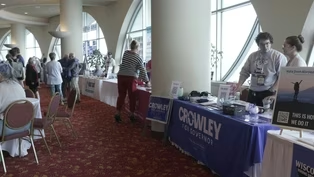
NewCandidates for Governor Make Their Case to The Parties
Video has Closed Captions
Clip: S2400 Ep2449 | 5m 45s | Candidates running for governor made their appeals at the annual party conventions. (5m 45s)
 New
NewDane County Returns 165 Acres to the Ho-Chunk Nation
Video has Closed Captions
Clip: S2400 Ep2449 | 5m 55s | The Ho-Chunk Nation will receive 165 acres in a land transfer funded by Dane County. (5m 55s)
 New
NewHere & Now opening for June 19, 2026
Video has Closed Captions
Clip: S2400 Ep2449 | 1m 8s | The introduction to the June 19, 2026 episode of Here & Now. (1m 8s)
 New
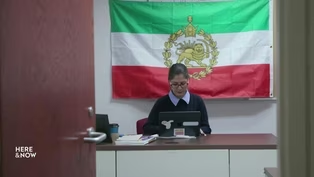
NewIranians in Wisconsin React to US-Iran Peace Negotiations
Video has Closed Captions
Clip: S2400 Ep2449 | 5m 56s | Iranians in Wisconsin discuss the Iranian government in light of announced peace talks. (5m 56s)
 New
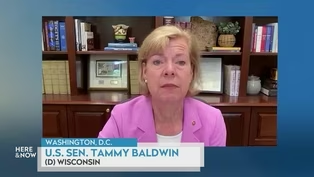
NewWisconsin Senators on The Memorandum of Understanding
Video has Closed Captions
Clip: S2400 Ep2449 | 1m 33s | Tammy Baldwin and Ron Johnson on the announced peace talks to end the Iran war. (1m 33s)
Providing Support for PBS.org
Learn Moreabout PBS online sponsorship New Episode
- News and Public Affairs

Top journalists deliver compelling original analysis of the hour's headlines.
 New Episode
- News and Public Affairs

Today's top journalists discuss Washington's current political events and public affairs.


 New Episode
 New Episode
 New Episode


 New Episode
 New Episode
 New Episode
Support for PBS provided by:
Here and Now is a local public television program presented by PBS Wisconsin