
Sept. 2, 2026 - Full Show
9/2/2026 | 26m 51sVideo has Closed Captions
Watch the Sept. 2, 2026, full episode of "Chicago Tonight."
What to know about controversial license plate readers. And calls for changes to funeral home oversight in Illinois.
Problems playing video? | Closed Captioning Feedback
Problems playing video? | Closed Captioning Feedback
Chicago Tonight is a local public television program presented by WTTW
WTTW video streaming support provided by members and sponsors.
Sept. 2, 2026 - Full Show
9/2/2026 | 26m 51sVideo has Closed Captions
What to know about controversial license plate readers. And calls for changes to funeral home oversight in Illinois.
Problems playing video? | Closed Captioning Feedback
Where to Watch Chicago Tonight
Chicago Tonight is available to stream on pbs.org and the PBS app.

WTTW News Explains
In this Emmy Award-winning series, WTTW News tackles your questions — big and small — about life in the Chicago area. Our video animations guide you through local government, city history, public utilities and everything in between.Providing Support for PBS.org
Learn Moreabout PBS online sponsorship>> Hello and thanks for joining us on Chicago tonight.
I'm Brandis Friedman.
Here's what we're looking at.
Law enforcement tool or invasion of privacy.
What to know about the rise of controversial license plate readers.
And after a grisly discovery at a south during funeral home, residents call for changes.
State oversight.
>> First off tonight, it's not just Chicagoans who needed a break from today's scorching temperatures.
The Dusable Lakeshore Drive bridge malfunction today during a bridge lift preventing it from closing 4 hours and backing up traffic.
The Chicago Fire Department was seen spring water on the bridge.
There it is apparently to cool it down.
The roadway opened around 3 this afternoon.
Meanwhile, the National Weather Service says today's high at O'Hare was 95 degrees with a heat index of 100.
The heat advisory for our area ends at 9 tonight.
But tomorrow has the potential for more of the same with a high around 93 and a peak heat index of 105 degrees in the city of Chicago.
Hundreds of splash pads are still open in city parks.
And so our 20 pools and dozens of cooling centers, you can visit our website for a map of locations.
The month of August saw its fewest homicides for that month in 15 years.
Chicago police say there were 39 homicides in August.
The lowest total since August 2011 so far this year, there been 289 people killed in the city.
That's 2 more than recorded at the same time last year 2025 closed with the city's lowest homicide.
Total in 60 years.
Data also shows robberies are down.
23% year to date burglaries down 11%.
Cpd also says violent crime on CTA, trains and buses.
That's also down 45% in August.
And 32% for the year.
And if you think Grant Park needs bathroom upgrades a redesign dog park or picnic tables and benches.
Now's the time for you to tell the city the Chicago Park district's participatory budgeting process means people can vote for one of those 3 ideas.
They were chosen from several submitted to steering committee to find out where you can vote either online or in person through the end of September September.
You can check out our Web site.
The debate over license plate readers right after this.
>> Chicago tonight is made possible in part why the Alexander and John Nichols family.
The Pope Brothers Foundation.
And the support of these donors.
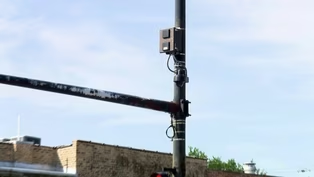
>> Automatic license plate readers, especially cameras from the maker Flock, are causing controversy nationwide.
Billions of vehicles are scanned every month, including some read by thousands of cameras in the Chicago area.
Advocates say the plate readers help law enforcement find crime suspects.
But critics have concerns over privacy and misuse of the data.
Joining us to talk more about this are Bianca director of communications and public policy at the American Civil Liberties Union of Illinois.
And Christian Hamm and professor of computer science at Northwestern University.
We also invited several law enforcement agencies and associations but have not heard back.
Gentlemen, thanks to the 2 of you for joining us.
Good to be here.
Christian.
Explain this technology thanks.
Explain this technology for us.
What exactly do flock cameras do?
>> I if they take pictures, they're they they're they have an ongoing.
They take an ongoing stream images triggered to some extent by movement.
But what they do is they gather that they got data and they do it now says the allows the system to tell you what car you're looking at, what the license plate is, what the make and model is.
It doesn't to 5 people, but it doesn't.
Dana, cars, they're driving down to a very very high level of precision.
And the thing that's powerful about it is, of course, that because I'm have them situated you know, it's area I can literally track someone out there driving or as they have driven.
And that's the that's the power, the strength and the danger of the system.
>> And it scans pretty much every car that that that it passes, right, that that can be read by that camera.
Oh, yeah, So it mean it's it's like any, it's like any other.
>> Sort of ongoing surveillance summit sometimes triggered by motion, sometimes was on.
But it's it's it's too to recognize vehicles and the features of vehicles that matter again make model color license plate.
Then the important thing to understand is that even though the data it collects might seem benign.
There's other data that can be connected to it.
That is if you know a license plate, you know the license plate of the car of a car.
You probably know who the driver as who the owner is.
You probably know what the fit that the but they look like you might be able to connect it to a whole bunch of other things having to do with what the what the state really already knows about us.
All right.
And that's the that's the place where it is.
>> That's okay.
So, Ed, let's get into that.
You know, these cameras have been around for some years, right?
I know that the Illinois State Police using a different manufacturer for some time, for example, by the recent controversy.
>> I think there's 2 reasons.
So bees cameras mainly were sold like many surveillance systems as being answer to enhance public safety.
What we haven't really seen in the last few years is transparency to see whether or not they're actually meeting those promises, whether or not the cameras themselves are hoping in terms of providing public safety.
But what has become very obvious over the last I would say said, you know, maybe 18 months to 2 years is that the cameras are rife for abuse.
They are right for being used for people using them to identify, for example, or for for someone to search for, say a former love interest.
As we've seen recently, an officer literally searching up a license plate more than 1000 times because it became, you know, with associated with someone with whom they wanted to or had had a relationship.
We've seen the cameras used in and around, for example, no kings rallies in some places around the country.
And we've even seen request for the camera data.
You know, as the professor pointed out to know where people move, we've seen that day to be requested from other states when people came here to seek lawful health care in Illinois, that is it lawful in their states.
That's not what we were promised with these cameras.
And I think that's the reason they're starting to be, you know, question by people both, you know, of all political parties and really, of all sort of partisan strikes and specifically that health care that you're referring to is people who come to Illinois seeking an abortion from right where it is not legal, correct?
>> Because there are also concerns about the violation of 4th Amendment protections against unreasonable search and seizure on because if a law enforcement agency should, you know, see a plate and then run that plate to find out if there are any warrants, whatever.
>> What are what are constitutional concerns around us?
So the cat, the basic constitutional concern is and I think, again, I want to go back to what Professor Hammond said.
It is recording every single vehicle that's present in a particular place.
>> And it's creating a tracking of where that vehicle was at a particular day and the particular time.
And there is no evidence at the time that is collecting and storing that information that someone is involved in any kind of criminal activity, let alone violent criminal activity.
And so the concern is, is that then when you are able to go back and search that data and be able to track, for example, where someone wet that you're you're able to essentially follow someone track them and look at what they're doing without any sort of probable cause without a warrant or without any of that, because the usual kinds of court oversight that we would really demand under our constitutional system.
>> Christian just mentioned this, there have been several recent incidents where police officers misuse the readers for personal reasons, stalking a former or stalking ex or a former boss, for example, what are some of the safeguards that should be in place to ensure that this doesn't happen?
>> What I think is that there's a great there's a great word here that can be used and that is you don't want the use of this, this technology or the date associated to be unwarranted, which is to say you want a warrant I mean, there aren't there got to be very specific reasons for using the technology and what happens is that it's so easy to use and so easy to access.
And it's Scott such scale all you certainly have all the abuses having to do with stalking and ex-girlfriends and looking at your wanted to find out, you know, yours, maybe your spouse's behavior.
So those abuses are right there ready for us.
And that's the first thing to get rid of those.
It's like this like has really strong, strong mandated regulation around that.
But there's also this odd thing of this is the kind of data we it sounds like it's normal data, but it's a kind of data we don't know about any more.
And that is if I can, if I can track behavior across a month, it might turn out that they're constantly going to a neighborhood.
And if I'm up, I'm if I've got crime on my mind that I'm thinking, oh, they're there.
They might be going there to commit a crime or had been committing crimes or if there was a crime there.
I can look at these people.
But that's not the behavior at all.
It's just somebody maybe going to the grocery store every day or picking up, you know, picking up a newspaper.
mean, that we don't know how to interpret the patterns that we're seeing.
And and our interpretation immediately goes to my job is to find criminals.
I'm gonna use this to find criminals.
Even though there might absolutely no connection between a crime and these behaviors.
And that's a huge danger.
And that is we we get confused because we've got data ahead of us.
We've gotten our hands that somehow it's meaningful for us and it might not be at all.
And that's I think a huge danger.
didn't.
I go ahead.
Go ahead, Professor.
I mean, one thing for me, though, is making sure that we understand this is not a technology problem so much this is a there's a huge regulatory that is we have to draw the lines.
in terms of utilization, but out tell you, if I if one of my kids vanished, I want every single one of those images I tracked with par I mean the yet But I want to up.
I don't Head back.
>> But you don't want to track He would want to find your did, of course, which is different.
You know, when you're looking for a minor, you're you're going to add about the regulatory can tonight.
I think that's right.
Because there's there's sort of 3 things, first of all, in many localities locations.
These cameras were deployed without any public discussion without any dialogue about how they would be used about what kind of crimes they would be used for and who would have access to.
So that's the first thing is creating transparency around this second, their walk to actually be a crime.
There ought to be limits on the kinds of crimes that can be search.
And then the 3rd, the second part of that is that there ought to be a very limited number of people who can have access to that data.
And 3rd, if there are violations, it just the way the professor was talking about and drawing those lines.
Have to be accountability for that.
You know, we're hearing so much about this right now and about, you know, officers being suspended or being, you know, being disciplined or whatever.
But that that that for tense, that this is the first time we've known about this and to have this kind of powerful tool in the hands of local law enforcement officials.
We ought to have as a community, an annual or semi-annual audit in which they were.
take a look at who's searching for what and what's the outcome?
You know, the question is really, is any of this actually benefiting us in terms of terms of being more say, well, it to that point, does it does the data show and in about 30 seconds data show us that this keeps us The thing is, is that every time the cameras are cited as something that's helped to resolve a crime, usually there some other factor that was involved as well.
And so a real audit of this is the kind of thing that the public could put its trust.
And in terms of whether or not these cameras are actually benefiting us for all of the problems that the professor is identified.
Okay.
Probably not the last time we're going to talk about Christian him and at Thanks both Thanks.
Thanks for having me.
Up next, local officials want to see changes to funeral home oversight in Illinois.
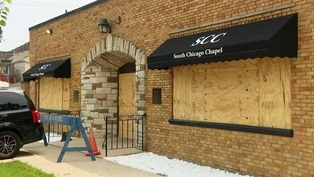
>> The grisly discovery of 56 decomposing bodies at the South Chicago chapel sound during last month raised more questions than it answered among them.
How did the fuel home evade state oversight for years leading up to that Discovery?
Illinois laws governing funeral homes and crematoriums have come under more scrutiny as leaders asked what it might take to prevent the next tragedy.
Joining us now, our state Representative Diane Blair, Sherlock, a Democrat whose district includes Villa Park in Glendale Heights.
She also chairs the House State Government Administration Committee.
Trevor Davies, president of the Illinois Funeral Directors Association and state Representative Marcus Evans Junior, a Democrat whose district includes parts of South Chicago, Calumet City and Lansing, thanks to the 3 of you for joining us.
Representative Evan, starting with you, what has been the reaction from constituents since this discovery in South Chicago?
>> It's really outrage.
And even beyond that, it's people picking You know, folks, war treated terribly body, bad actors.
And it's just horrific.
But I think he's been joyous indices because the community will go up.
Attention was brought in a problem will stop.
But now that we stop the bad actors moving forward, municipal Diane Blair, Sherlock and others.
And Trevor, get in That doesn't happen again.
What a terrible, terrible thing locally.
>> Trevor Davies, what responsibilities do funeral directors have to to families who trusted them with their loved ones?
>> From the moment death occurs, funeral directors become not only a guide and advocate, but they are often just a presence for a family who may not know what to do next.
Directors coordinated transfer of transferring care of persons loved one to ensure proper identification documentation, complete necessary paperwork and Courtney things.
But cemeteries crematory is those types of things.
You know, try to get everybody is involved in the process together.
But are our responsibility goes well beyond paperwork and logistics.
We care for the deceased with dignity and respect and whether that involves and bombing the preparation, cremation arrangements, burial or another form of disposition.
Families play set and extraordinary amount of trust in U.S.
and that trust is something we don't take lightly and handling someone that they care so much are so that we can take care of that.
And we have a professional ethical responsibility to protect that person's dignity and respect there, every step of the way.
>> Representative Bush how his funeral home oversight and Illinois currently divide it up.
>> Oh, that's the problem, isn't on?
So there's actually 3 different entities that are involved with respect to that.
So you've got the IDF PR, which does the licensing for the funeral directors and Embalmers Illinois Department of Financial and Professional It And then you have comptroller's office.
Who does crematoriums and then you have local health departments that would take care of things like sanitation.
We just recently passed a bill this last spring session to strengthen the counselors powers with respect to crematoriumswe increased penalties.
We enabled on her to take quick action without necessarily sharing in the most egregious circumstances and 4, the on.
>> Local.
>> Depending on where you are on.
traffic that they're called.
But the the medical examiner, medical examiner, thank you or depending on where are county, they step and take control.
The remains immediately, right so that they can take care of that.
And as you know what this recent incidents, they're trying to identify all these people, right?
It's appalling.
And I think that the problem with having 3 different people are 3 different entities involved.
We're not necessarily having the type of oversight that we need to have.
And I believe that the General Assembly working with the funeral industry.
I don't think that the funeral industry wants these things to happen, right?
I believe that there are very good actors in the space and that they will work with us and we will be able to come up with a framework that will ensure that these types of things don't happen again or if they do, we catch them much more quickly well.
Trevor, as a representative of members of the funeral home industry, how is the current system working for funeral directors?
>> As it, as the representative mentioned, only currently has a frame fragmented regulatory structure for death care.
well, we do this.
I think the current situation raises legitimate questions about whether regulatory framework taken as a whole provides a level of oversight communication and inspection and accountability to Illinois.
Families deserve.
I think all families deserve should have somebody who's licensed and inspected identifiable and accountable to take care of them.
And those things are all important and moving forward, Illinois's families should be able to rely care regulatory system that is clear accountable and responsive fear.
Professionals who follow law and maintain high should likewise have confidence that those standards are being applied consistently across the profession.
purpose of reforms should not be regulation for regulation sake.
It should be to modernize an outdated regulatory structure, strength their strength consumer protection address, actors and avoid unnecessary burdens on para professionals who are already doing things correctly.
>> Representative, where Sherlock is creating a unified funeral board.
So one agency that would do the duties of these other, you know, 2 to 3 agencies.
Is that something the state should?
know that we need an entirely new agency for this.
I think that we could fit this under the umbrella of an agency.
I do think having a system where we could have periodic checks, right inspections, stone of facilities to ensure that the your part month, though, who would want to to be determined right?
this is why these discussions are happening.
So we have not landed on that.
And if you know anything about the legislative process, right, there's a lot of discussions first and we have a lot of stakeholders involved here.
So we've got the comptroller's office.
We've got the local health departments.
We've got the on a Department of Financial professional regulation.
We've got the funeral industry.
So we all need to come together and say, where does this past that right?
And I don't think we know yet where this pest but there are conversations happening now that hopefully will lead to determination.
Representative Evans.
>> they won't public trust.
This number one.
And what representative like is explaining is the process of good government and you won't discusses you just don't want reactions that thinking up live.
The vast majority, the 99.9% of individuals in this space take care of their loved ones.
I first heard this and I know Trevor and his members probably call while ahead what they do this in the first place.
doesn't make any logical sense.
You want to process the bodies.
You want to take care of people.
You want to take care of customers who want to make the money like you're probably was never going to be hit and you can hide dead bodies.
So it made no This was in lead is bad actor.
I want live the good funeral home crematory serves individuals.
And I Representative Berlin, like is correct.
Want to make that we don't just put order was regulations on the good folks of waste.
A lot of time.
Well, as those people wasted, but want to make to it.
They could tie put a bad actors.
Representative Evans, do you see any policy gaps that allowed the South Chicago chapel to get to the point that that it got to get as bad as it did.
>> Well, I think I wouldn't go as far as gaps.
I just want to I think we were pretty tight on the regulations.
>> The problem was on top of these folks, and that the husband license, the wife continue to operate right.
But she was still watched.
I some bad actors does go beyond.
But we but OK, we're going to do all we can to tighten it A bully representative served by.
Robot with some of the folks in the industry.
We can make it nearly impossible.
think there's a lot of ideas floating around.
The more inspectors hiring.
Will folks to make sure we go take every single complaint?
I think there's things that we can do all those being on table.
I don't hear representative for like Trevor is and now once we get this set is going to be nearly impossible for to happen again.
>> Trevor, there was a bill that was passed in Springfield believes represent Representative Charlottesville.
related to that tragedy at the crematorium, as she mentioned, do believe was also related to the owners there's been reporting to the owners of the South Chicago chapel.
But how do you think whatever new legislation is developed?
How do you think that that can prevent?
You know what we know to be bad actors without causing undue burden on everyone else.
The ones you say who are doing their jobs with respect and honor.
Sure.
>> You know, I think the biggest thing if a business is holding itself it out there.
Still many families as a funeral establishment requirements by operating primarily or I'm If we're operating as apparel establishment and accepting responsibility for the care and the disposition of human remains, establishment itself should be accountable to the state.
There's no question about that.
Look his business.
OK, unfortunately, we're out of time.
We're going to have to leave it there.
But something we'll be keeping an eye on and hopefully hear back from the 3 of you on further down the road.
>> My thanks to State Representative Diane Blair, Sherlock State Representative Marcus Evans Junior and Trevor Davies.
Thank you.
Thank you.
Thank you.
And that's our show for this Wednesday night.
If you're looking for more context on the complicated issues that matter most to you, sign up for our e-mail newsletter, the Daily Chicago and you can do that at W T Tw Dot Com Slash newsletter and join us tomorrow night at 5, 30 10.
Now for all of us here at Chicago Brandis Friedman, thank you for watching.
Stay healthy and safe and have a good night.
>> Closed captioning is made possible by Robert a cliff and Clifford law offices, Chicago, personal injury and wrongful death that supports
 New
NewCalls for Better Oversight After 56 Decomposing Bodies Found at Chicago Funeral Home
Video has Closed Captions
Illinois laws governing funeral homes and crematoriums have come under scrutiny. (10m 50s)
 New
NewHelpful Tool or Invasion of Privacy? What to Know About Flock Cameras
Video has Closed Captions
There are hundreds of license plate readers in Chicago. (10m 28s)
Providing Support for PBS.org
Learn Moreabout PBS online sponsorship New Episode
- News and Public Affairs

Top journalists deliver compelling original analysis of the hour's headlines.
 New Episode
- News and Public Affairs

Today's top journalists discuss Washington's current political events and public affairs.



 New Episode
 New Episode
 New Episode
 New Episode
 New Episode
 New Episode

Support for PBS provided by:
Chicago Tonight is a local public television program presented by WTTW
WTTW video streaming support provided by members and sponsors.