
September 7, 2026
9/7/2026 | 55m 48sVideo has Closed Captions
Rahm Emanuel; Bill McKibben; Emily Wilson
Former White House Chief of Staff Rahm Emanuel discusses Israeli PM Netanyahu’s visit to the U.S. Environmentalist Bill McKibben talks about the wildfires blazing through Europe. Bestselling “Odyssey” translator Emily Wilson discusses the public discourse around Christopher Nolan’s “The Odyssey” and her own work.
Problems playing video? | Closed Captioning Feedback
Problems playing video? | Closed Captioning Feedback
September 7, 2026
9/7/2026 | 55m 48sVideo has Closed Captions
Former White House Chief of Staff Rahm Emanuel discusses Israeli PM Netanyahu’s visit to the U.S. Environmentalist Bill McKibben talks about the wildfires blazing through Europe. Bestselling “Odyssey” translator Emily Wilson discusses the public discourse around Christopher Nolan’s “The Odyssey” and her own work.
Problems playing video? | Closed Captioning Feedback
Where to Watch Amanpour and Company
Amanpour and Company is available to stream on pbs.org and the PBS app.
Watch Amanpour and Company on PBS
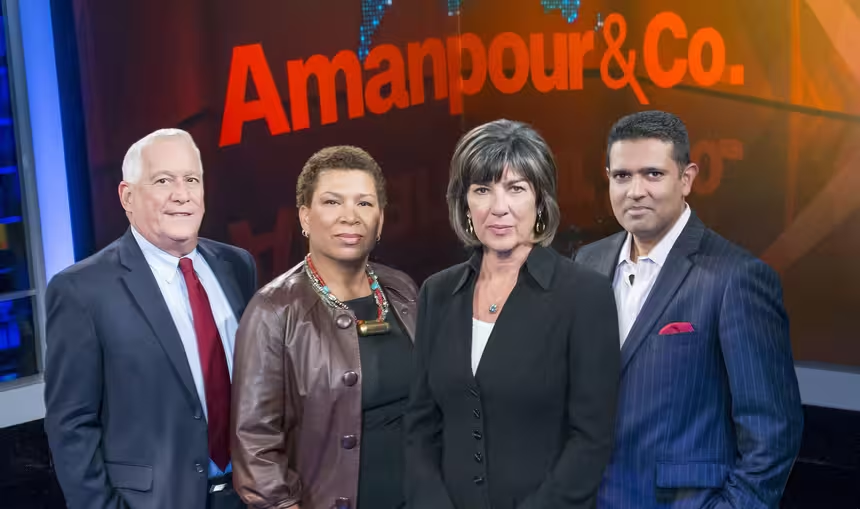
PBS and WNET, in collaboration with CNN, launched Amanpour and Company in September 2018. The series features wide-ranging, in-depth conversations with global thought leaders and cultural influencers on issues impacting the world each day, from politics, business, technology and arts, to science and sports.Providing Support for PBS.org
Learn Moreabout PBS online sponsorship(logo whooshes) (dramatic music) - Hello, everyone, and welcome to "Amanpour & Company."
Here's what coming up.
- Frankly, we've been very nice to a lot of countries that would not survive without us.
And you know who wouldn't survive without us?
Israel.
- [Amanpour] Netanyahu meets an aggravated Trump in Washington.
Is this a low point for the US-Israel relationship?
I ask Rahm Emanuel as he weighs out political ambitions for 2028.
Then... - [Translator] The situation we are dealing with today is the most severe we have ever recorded, the toughest since the Second World War.
- [Amanpour] France says it's at war with devastating wildfires.
They rage in Spain, too.
Its capital, Madrid, is under threat.
Renowned environmentalist Bill McKibben joins me.
Plus... - One of the many reasons "The Odyssey" is having a moment in the 21st century is the fact that it is, the original poem, is so much concerned with these questions about, what does it mean to be a good host and what does it mean to be a good guest?
- [Amanpour] "The Odyssey," still capturing imaginations 3,000 years later.
Walter Isaacson speaks to Emily Wilson, the first woman, and the latest, to translate the epic into English.
(bold uplifting music) - [Narrator] "Amanpour & Company" is made possible by: the Anderson Family Endowment, Jim Attwood and Leslie Williams, Candace King Weir, the Sylvia A. And Simon B. Poyta Programming Endowment to Fight Antisemitism, the Straus Family Foundation, The Peter G. Peterson and Joan Ganz Cooney Fund, Charles Rosenblum, Monique Schoen Warshaw, Koo and Patricia Yuen, committed to bridging cultural differences in our communities; Barbara Hope Zuckerberg, and by contributions to your PBS station from viewers like you.
Thank you.
- Welcome to the program, everyone.
I'm Christiane Amanpour, in London.
Two high-stakes meetings at the White House today as President Trump met with Ukraine's President Zelensky and Israeli Prime Minister Benjamin Netanyahu, both in town for Senator Lindsey Graham's funeral.
For the Israeli leader, though, the Washington reception of today will be very different to the last one.
Polling now consistently shows a huge drop in support for Israel over the past few years, in reaction to the Gaza war and increasing attacks in the occupied West Bank.
The Jewish advocacy group J Street issued a statement that, quote, "The bipartisan consensus "Prime Minister Netanyahu once claimed to have built "has been fractured not despite his policies, "but because of them.
"And he no longer speaks for millions of us."
Now, the relationship with Israel is also emerging as a new litmus test for the Democrats.
Rahm Emanuel, formerly a US ambassador to Japan, a White House chief of staff, and a congressman, has been a long-time supporter of Israel.
He, himself, volunteered to serve in the IDF.
But he now says the US should not provide its long-term ally with unconditional military aid, arguing Israel should be treated like any other country.
And Rahm Emanuel is joining me now from Chicago.
Welcome back to our program.
We've got a huge delay, so I'm not gonna wait for you to say "Hi" back, but let me ask you this, do you agree with how I framed my introduction to you, that Netanyahu comes to Washington at a time of maximum, let's say peril for relationships between Israel and the United States?
- The truth is yes and no.
It is a maximum peril from that perspective.
What I said was, and I've always believed, Israel can buy weapons like any other ally, not any other country, with the same rules, same restrictions, and same requirements as any other ally.
Pay full price, they just won't receive US taxpayer support.
As I said in my speech, it will maintain its qualitative edge.
Third, which is very important for the context, in 2021, Michael Oren, the Israeli ambassador to the United States, came out for the same position.
Now the prime minister has adopted it.
So that was a piece of it.
And then I laid out a 2023 state peace solution and also the India-Middle East-Europe Economic Corridor.
So there was a way of breaking out of Israel's isolation.
And I say it also as an American patriot, the final point that I think is important.
America has fought two very stupid wars that have cost us thousands of lives, trillions of dollars, in the region.
I'm not looking for a third war.
And as a principal ally, that means we have to have an understanding, because we're at a breaking point, as I said in the speech.
We're at a tipping point in recalibrating what this alliance is about and what we have to do to secure Israel's sovereignty and security, but not at the expense also of America's interests.
It has to be complementary.
- So, so, so now that you've laid out that table, that's good to know.
I wanna know what you think, because there's been a lot of back and forth about who was really responsible, who is the father of the war on Iran?
President Trump says, "It was me.
"I'm the leader of the free world, it's not Netanyahu."
Others believe that it's Netanyahu who had convinced him with what turns out to be faulty intelligence, that it would be an easy, once in a lifetime, once in a generation slam dunk.
What do you think, and what do you think, we haven't had all the details yet from the meeting with President Trump, but, what do you think President Trump is and should be saying to Netanyahu now?
- Yeah, well, one is, look, I never give a president of the United States a pass.
I know one thing, having been served two presidents in the Oval Office, spent eight years in and out of it, the only decisions you get in the Oval Office, like a mayor of a big city, are bad and worse.
And you have to have the judgment to distinguish bad and worse.
Prime Minister Netanyahu has been talking to four different presidents who rejected this idea.
President Bush, 43; President Obama, President Trump 1.0, and President Biden all said no to this.
So President Trump doesn't get a pass.
Did Netanyahu finally get him to say yes?
He did say yes, and that's on the President.
The president of the United States is required, as a commander-in-chief, to secure America's national security interest and also the men and women who serve that interest, and look out for them.
So I don't give a pass to the President of the United States.
Now, I also believe if you put this war up against President Obama's JCPOA, for all the goods and bads, here's how you juxtapose it.
China and Russia were enforcing with the United States Iran's ending of its nuclear, or limiting of its nuclear capacity.
Today they're funding Iran and supplying Iran in its war against the United States, killing Americans.
Two, the JCPOA had the uranium out of Iran.
Today the uranium is in Iran.
Third, the uranium was down to 3% purity.
Today it's at 90% purity.
Fourth, the Strait of Hormuz was open.
Today it is closed.
And fifth, the world was part of isolating Iran and making realized the cost of that nuclear project versus then.
Nothing in politics is perfect.
Go to another profession if you want perfect.
In the balance of equities, the JCPOA was the right decision versus this decision.
The President of the United States has now got the United States in a war with Iran that has, not only he doesn't have leverage, you now, having replaced the proxies, Iran's using the Strait of Hormuz as its leverage on the world and trying to achieve its ultimate goal, push America out of the region, which is why it's bringing the cost to the Gulf countries from Kuwait, UAE, Bahrain, Oman, Saudi Arabia, and Iraq to be too burdensome, and Qatar, too burdensome to have the United States.
So, to me, this was on the President.
He has the agency, as a commander-in-chief of the United States of America, and the responsibility.
Prime Minister Netanyahu sold that to four presidents, and all of 'em said, "Not buyin'."
This is the president that bought it, and it was a mistake then and it's a mistake now.
- Yeah, and clearly you can see the dramatic loss of public support, even from the beginning.
Very rarely in the United States do wars not have public support in the beginning.
Not this one.
And the oil prices keep rising and the Republicans are in a bit of a tizzy over all of this.
I just wanna correct you, just because it's a fact, Iran has 60% in rich uranium because 90% is actually over the top.
So I know you meant 60%, I'm just gonna make it clear that it's 60%.
- That's fine, thank you.
Thank you for the clarification, but before, it was, under the JCPOA, it was 3%.
- I know, I know.
It's not, I know.
So let me ask you this.
Going back to Israel, because this has now become a big deal in the United States.
And the politicians are sort of kind of trying to be on what they consider to be on the right side of this issue, particularly for future political ambitions.
Now, I wanna go back to your speech that you gave in Tel Aviv, where you actually called Israel, for, I mean, there's plenty of context, but a "territorial pariah."
You warned again, about unconditional US support, and you proposed sanctioning those Israelis who attack Palestinian civilians.
Here is a piece of your speech that I'm gonna play, and then you can describe it.
- The Prime Minister and his government have led Israel into a dead end.
For too long, American policy towards Israel operated under the assumption that the best thing Washington could do for Jerusalem is to blindly, to silently, stand behind your government, without conditions, without demands, without consequences, even when we disagreed.
That has been our mistake, and it's been not a favor to you.
- Rahm Emanuel, you know that the leading Jewish elected politician in the United States, the, you know, the Senate Minority Leader Chuck Schumer, back in 2024, made a similar plea from the floor of the Senate.
"Please, Israel, don't do this, "because you're going to alienate America, and, and, and.
"And you need America for your security, etc."
Do you think more politicians should've taken that up, that rallying cry back then?
- Well, hold on one moment.
Christiane, when I was President Obama's chief of staff in 2009, 18 years ago, I confronted the Prime Minister directly.
I said that the housing, what you're doing in the West Bank is not only against a two-state solution, it is not in Israel's interest.
It will lead to its isolation and perpetual conflict.
If there was a prediction I wanted to be wrong on 18 years ago, that was it.
Now, that's what led him to publicly call me a "self-loathing Jew."
I was there 18 years ago.
Everybody else caught on.
I didn't need the Gaza war to realize that the policies vis-a-vis in the West Bank, specifically the housing settlement, were gonna be provocative and lead to something like this moment.
And I said it not behind the Prime Minister's back, to his face, which is why he attacked me not only publicly but also in his book.
Number two, also, and I wanna repeat this, many members of the Israeli security establishment and members of the Prime Minister's government who joined after October 7th, quit because there was no day-after plan in Gaza.
You've never used the military to then create strategic opportunities and fill them with political persuasion, diplomatic success, economic statecraft, or cultural attraction, the other tools of your national security toolbox.
So, you know, I have to, not only also said that to the Prime Minister, I was, I think, a persuasive voice to President Obama to fund the Iron Dome, because it's protected Israeli citizens from missiles targeting citizens, not military targets.
And I have no room for anybody that, on October 8th, was celebrating the death of 1,200 people, the sexual violence to those people, the taking of 250 people.
In that same speech that you just cited, I called those people who were celebrating October 8th morally bankrupt, and I think they're morally bankrupt.
I also criticized the Palestinian leadership for its corruption, for turning down three times, 98%, of what they wanted and responding with violence.
I got the cynicism.
But to break out of what I call the Israel that was once known as a startup nation that is now wanting to buy the Prime Minister's own term becomes Sparta.
A policy of a 23-state solution, which was the Arab League's offer in 2013, Saudi Arabia was the principal backer.
They need the comfort of numbers today.
They will give full recognition to the state of Israel for coming to an agreement on sovereignty and security.
Israel wants the comfort of numbers because they break out of their pariah status.
The Palestinian's people get the sovereignty they need, and America would've brought together the stability the Arab world requires, the stability that Israel requires, and the sovereignty that the Palestinian people require.
That makes the politics work towards the policy.
And I don't think the United States was doing any favors by being so silent when it was against our interests and our purpose.
And it was so, not only the Prime Minster called me, you can read about it in former secretary of state Hillary Clinton's book, the most vocal voice against the housing policies on the West Bank was myself, as President Obama's chief of staff.
So I've been consistent for 18 years.
I'm sorry everybody else is a little late catching up.
- (chuckles) Regarding what you said about October 7th, I think most right-thinking people would agree with you on how to reflect what on what happened on October 8th.
- Actually, I wanna call this out.
- I know, I know.
- Christiane, no, I'm not.
I'm not gonna let you get past on this, no.
No, there is a lot of people in public life in America-- - There are, you're right.
- And around the world.
Who were cheering on October 8th after 1200 people dead.
- That's why I said most "right-thinking" people.
I know, I know.
- Well, the other thing is thinking, as well as right.
- That's why I'm agreeing with you.
- I'm not giving it a pass.
- Correct.
- It's morally bankrupt.
- No, you're right, it's morally bankrupt.
You are right, and I'm telling you that.
- As is what the Israeli settlers are doing on the West Bank and I'll take it again one more time.
As the Israeli settlers are doing right now, the violence, that is morally empty.
- Okay, so let me ask you this.
We've got an Israeli election coming up on October 27th.
I wanna ask you how you think that could change this view on October 27th, but in the meantime, some 600, I think they're former Israeli, you know, military, IDF, intelligence, and all the rest of it, have written an open letter, saying that only the President of the United States or the United States can tell Netanyahu to stop what's happening on the West Bank right now, and possibly also in Gaza.
What would you advise President Trump to say to Netanyahu about what you've just raised?
The settler violence, the government-enabled violence on the West Bank right now?
- Yeah, to some elements of the Jewish community that criticized my speech, I said, look, man, there is 100 Israeli IDF generals and members of the Shin Bet leadership who said the same thing.
What do you know that they don't know about Israel's security?
That the settler violence is not an Israel security interest.
And you're gonna perpetuate a type of conflict.
This is not in Israel's interest.
You said 600.
About a month ago, it was 100 names.
So to all the people that, again, getting back to the core thing, (indistinct) being silent about something we disagree with.
Remember, there are voices inside the security establishment in Israel.
Generals who held the highest position in Israel who believed in the security have criticized this decision.
Second thing I would say to Israel, you have a president in Syria.
Not an Assad, which has been a leader, the family's been a leader for over 40 years.
He has called for a security agreement with Israel.
Not a peace, but security.
You have a peace with Jordan, you have a peace with Syria.
You get Syria worked out, that's a major security plank.
Europe would be part of that, France for sure, and others would be supportive of that.
And you have now basically taken the country that Iran used as Route 66 to Hezbollah's weapons, you would take them out of the commission of being that route.
And that is in Israel's both Golan, northern Galilee security, as well as eliminating the route that Iran has used to get Hezbollah the weapons.
Let's work on that and make that a public part of Israel's profile to the world, working on peace.
In Lebanon, you now have a unique partnership and capability.
We have an oil agreement in the Mediterranean.
Now they wanna take over, squeezing Hezbollah out, so making sure Israel's northern border and the people living in Kiryat Shmona and other parts are secure.
We're gonna make that a priority.
And I would tell the Prime Minister, you have to work on these as part of the security for Israel, but more importantly, also, for the security of the United States.
And we will be your partner, going shoulder to shoulder.
But we're not gonna go off on some journey.
And as it relates to the settlements, right now, those are cease to desist, you made a pledge not to undermine the West Bank.
You made that pledge as part of the Abraham Accords with the UAE, with Bahrain.
and you are undermining them.
And the other thing that's a part of this, Christiane, is the Prime Minster, when he first got elected, said, you know, "I'm gonna control my government."
Because of his political standing, the very, very far right-wing elements of his government are controlling him, and it's detrimental to Israel's security.
That's why those 600 generals, former generals, wrote a very public letter.
And nothing I ever said measures up to the criticism they have said on this prime minister and his government.
- I may have misspoken on the 600.
You're right on the hundreds of, nonetheless that's a detail.
- Yeah, I think it's 100.
I was gonna, that really grew.
(chuckles) We'll both stand corrected on two different things.
- Yeah.
We do.
All right, Rahm Emanuel, thank you for being with us.
And we'll keep following this conversation.
- Thanks!
- Now, to Europe burning.
Hundreds of thousands of people across France and Spain have been evacuated from their homes in recent days, as wildfires across those countries have continued to blaze.
Temperatures will soon soar in both countries this week, with no rain in sight.
Most of France is now suffering from poor air quality, too.
Listen to the Spanish Prime Minister, Pedro Sanchez, and the French president, Emmanuel Macron.
(Sanchez speaks foreign language) - [Translator] What we are living is not a succession of isolated events.
As has been said before, it is the most painful expression a climate emergency that is making six-generation wildfires more voracious, heatwaves more frequent, and, as a result, our territory more vulnerable.
- [Translator] The situation we are dealing with today is the most severe we have ever recorded, the toughest since the Second World War.
More than 160,000 hectares have already burned, and the season's far from over.
- Now, Bill McKibben is a globally recognized author and environmentalist.
His latest book is called "Here Comes the Sun," and he's joining me from Vermont.
Bill McKibben, welcome back to the program.
Just a reaction to what Prime Minister Sanchez and Emmanuel Macron said, I mean, I was really horrified when I heard Macron say they're facing the worst crisis since World War II.
- Well, of course he's correct, and he's joined by leaders, by now, in virtually every part of the world.
We're living out this story in place after place and place.
Where we live here in Vermont, we spent the last week with, our air just turned orange by record fires in Ontario, pouring smoke down upon us.
It's gonna get worse before it gets better.
But the only way out of it is the way that, ironically, Spain has been starting to pioneer, the rapid adoption of clean energy technology.
It gives us some hope of staunching the flow of carbon into the atmosphere from fossil fuels.
- So that's what I wanna talk to you about, because you have a lot of amazing facts and experiences for us to look at from countries and others that are actually doing the right thing on trying to mitigate climate change.
But first I wanna ask you, because the next big event, I think, is going to be El Nino.
Tell us what that is and what that will affect after this summer of wildfires.
- Yes, I'm afraid this is the appetizer, and we're heading for the very main course over the next 12 months.
The heat now building in the Pacific, which is what an El Nino is, will be expressed into the atmosphere over the next year.
And it's almost certain now that we will set new records for the hottest year in human history.
And in fact, there's increasing speculation studies yesterday that show we may, for a month or two, go past that 2.0 degrees Celsius mark that the Paris Conference of 2015 was supposed to do everything to keep us away from.
We're gonna get a foretaste over the next year of what the weather from 2035 or 2040 will be like.
And I'm afraid what it'll be like is even more chaos on the scale that we're seeing in France, in Spain, in so many places right now.
- Mhm.
Again, before I get to some of the solutions, let's just point it out that right now is what actually matters.
In February of this year, the EU science advisors said that the EU's current efforts to adapt to these rising temperatures are, quote, "insufficient, largely incremental, "and often coming too late."
And in the United States, paradoxically, some 61% of American voters believe that extreme weather is getting more frequent.
But many of them, according to another study, think that they're alone in their concern, that it's not, you know, generally accepted as a major issue that has to be dealt with.
Talk us just a little through European and US policies and politics on this.
- I think you could say that the Europeans are going too slowly, but at least they're moving in the right direction.
And I think you could say that America is making a concerted effort to make the problem worse as fast as it possibly can.
Donald Trump has explained that he thinks global warming is a hoax, a scam.
And we've shut down wind farms that are 90% finished off of the Atlantic seaboard, put the federal land off limits to solar panels, done every possible thing we could to buck up 18th century energy technology, new subsidies for coal, instead of joining the future, being led now unmistakably by China and increasingly, Christiane, by the rest of Asia.
You've talked a lot about all the different ramifications of the war in Iran.
One of the most important of them is going to turn out to be the realization from leaders everywhere that, though sunlight has to travel 93 million miles to reach the earth, none of the miles go through the Strait or Hormuz.
- That's a really good way of putting it.
So now I wanna ask you, you mentioned Asia, obviously Australia is all the way over there.
And you have talked about how Australia is really doing it right in that they have renewables, the sun, and that they have a lot of hours of the day where all their electricity and power is free.
Tell us how they figured that out.
- So Australia, let's begin by saying, is somewhat schizoid in this regard.
They're importing, exporting huge amounts of climate-wrecking coal and gas to the rest of the world.
But domestically, they've decided that the sun is the way to go.
They've put up so many solar panels, 40% of Australian solar houses have panels on the roof, that they now have a great excess of electricity at parts of the day.
All Australians, solar panels or not, can now get free electricity from 12:00 to 3:00.
It's half the country right now, and by next year it'll be the entire country.
This thing, energy, that humans have worked hard to pay for for hundreds of thousands of years, whether it's the time spent gathering firewood or the time spent working to pay the power bill, all of a sudden, the sun is delivering this extraordinary bounty if only we will take it.
And in the process, giving us the only escape route we have from the climate crisis that we're in.
We're not going to stop global warming.
Too late for that.
But we're not too late to start shavings tenths of a degree off how hot the planet eventually gets.
And at this point, every tenth of a degree that we raise the temperature moves 100 million human beings from a relatively safe climate zone to a relatively dangerous one.
It's the biggest task that humans have in front of them.
- So, you know, when we read, and when I researched for this interview, there is obviously good news.
And I think it's really important to put the good news out so that people can see exactly what you're saying, that there are methods to actually keep it under control, even if we can't stop it.
And I was really taken by the report that in 2, sorry, 2025 all new electricity demands around the world were met by green power.
That's pretty amazing.
I don't think many people know that.
And I just wonder, you know, what you think about, or how you think, for instance the United States, could they have this solar-powered free electricity for most of the daylight hours?
- You know, the US is where we invented solar panels, 1954 in Bell Labs in New Jersey.
We could, of course, be doing this.
We're just not because, as candidate Trump said to the oil industry during his campaign, "Give me a billion dollars in donations, "and I'll give you anything you want."
What they wanted was to get rid of Joe Biden's efforts to build out clean, green technology.
But the rest of the world is moving in different speeds in the right direction, and some of the stories are remarkable.
Look at Pakistan, a poor country that's suffered grievously from climate change but has the geographic advantage of a border with China.
No government program, just individual Pakistanis importing cheap Chinese solar panels and going on YouTube to figure out how to put them together, they've built the equivalent of half the country's national electric grid in 18 months.
I mean, it is amazing what this technology is capable of if we really got behind it and pushed.
We have an obvious group project as a world, if we chose to adopt it, and that is to, in very short order, build out sun and wind and batteries such that the planet runs on something other than coal and gas and oil.
And A, we can begin to ameliorate the climate crisis.
And B, we can stop fighting some of these stupid wars.
No one's gonna fight a war over sunshine, Christiane.
- (chuckles) Let's hope not, let's hope not.
But Bill McKibben, how do you create... I mean, it takes political leadership.
I know you mentioned the sort of grassroots, you know, work in Pakistan, with people taking matters into their own hand.
But if we go to China, for instance, you've explained how they, essentially I think this is what you were saying in your podcast with Ezra Klein, that they created, they spent a lot of political capital and time and energy creating a market, a domestic market, for these amazing, you know, climate mitigation technologies.
And the United States tends to do exactly the opposite.
It hasn't created the market, but it has the technology, after all.
Tell me about what China did.
- I mean, China's its own story.
China decided early on what they were going to do, and they put all the force, evade, command, and control economy behind it.
The US and Europe are obviously gonna be different in degrees.
Here in America, even with the federal government in the firm control of anti-environmental zealots, my colleagues and I at Third Act, our organization that organizes old people like me for action on climate and democracy, we managed to get 10 American states this spring to approve the legislation to allow residents of those states to put up the balcony solar or plug-in solar schemes that you've seen across Europe.
These are small, inexpensive solar panels that just plug directly into the wall and provide 20% of the power an apartment uses.
That's not everything, but it's not nothing.
And we've been able, even in the face of determined resistance from the fossil fuel industry, to really get ahead of steam here.
That's because people love solar power.
People across the political spectrum understand that this is the future.
We need to do that kind of organizing in order to give it the chance that it requires.
- And for a long time, renewables seemed to be more cumbersome, required more, quote, "sacrifice" to use, may have been more expensive than good old, you know, fossil fuels.
What is the reality of the price right now?
People who use renewables as much as they can, are they paying more for their energy or less?
- No.
Five years ago or so, we passed some invisible line on this planet where it became cheaper to produce energy from the sun and the wind than from fossil fuel.
Now, the cost of renewable energy is all upfront.
You have to buy the solar panel.
But once you have, then the energy is delivered for free every morning when the sun rises above the horizon.
And now we have cheap battery technology to allow us to store the afternoon away and use it at night.
So that's what been so transformative, and frankly, that's why the fossil fuel industry is so terrified and why they're working so hard and so corruptly to game the system to keep it from getting even more of a foothold.
- Tell me your story about President Carter.
Back in the '70s, there was the oil crisis there, and he did all sorts of things, including putting solar panels on the roof of the White House.
What did he tell people back then, tell the American people?
- What he told people was, that the sun was, in fact, the future.
And in his last budget, he put aside enough R&D money that the plan was for America to be producing 20% of its power from the sun by the year 2000.
Had we done that, we would live in a very different world today, a much cooler one, because this renewable revolution would've been pushed forward several decades.
Instead, of course, Ronald Reagan was elected over Mr.
Carter, and he took down those solar panels from the White House roof.
More importantly, he took that money out of the budget and locked us into this cycle of endless drilling for more oil that's come to define not only America's economy but America's politics.
As you know, Donald Trump has said his plan is to exert energy dominance across the earth by America's control of oil and gas.
I don't think that's going to work, but I do think it runs a very strong risk of turning America into a kind of theme park of internal combustion while the rest of the world gets its act together very quickly.
We're being left behind, and I'm not sure there's even been a kind of act of national economic self-sabotage to compare with the last 18 months.
The country that invented the solar panel and the industrial wind turbine and the lithium ion battery is now the country seeding all of that advantage to our theoretical chief adversary.
- But just to be clear, it's not too late to stop and take the right path?
- Not at all.
We're obviously wasting time now, but we can and should be building out renewable energy in all the places that are possible.
America needs... America's going to be the caboose for a while here, but we need to join that train, and fast.
- Okay, Bill McKibben, thank you so much for being with us.
Now, Christopher Nolan's cinematic rendition of "The Odyssey" is a massive box office hit.
Let's take a quick look.
- I think his king is coming back.
- No, he's not.
(dramatic music) - What would he do if he came back here to find all these suitors in his house?
(character grunts) - You're pining for a daddy you didn't even know, like some sniveling bastard.
(intense music) - Who's looking after your wife and son?
- Do you see?
- My dad is coming home.
- Bringing vengeance.
- Bringing it all.
Let's go!
(army shouts) (gripping music) - Now, she's not a movie director, but our next guest has spent much of her career with the original text of Homer's great poem.
She even wrote the English translation that influenced Nolan's film and has now sold over 1 million copies.
Emily Wilson is a professor of classical studies at the University of Pennsylvania, and she's joining Walter Isaacson to discuss how her translation differs from others, including Nolan's telling of the tale.
- Thank you, Christiane.
And Emily Wilson, welcome to the show.
- Thank you so much for having me.
It's great to be here.
- So you have this great translation of "The Odyssey."
It's becoming a best seller again because of you, and it's, of course, the movie.
But let's start at the beginning, the opening of Homer's epic.
You know, I'm old enough that I got to study it under Robert Fitzgerald, who did a great translation of it.
And he would read it to class.
And he begins with, "Sing in me, Muse, "and through me tell the story "of that man skilled in all ways of contending."
And then probably up until you, the most popular was the Robert Fagles translation for people.
And he goes, "Sing to me of the man, Muse, "the man of twists and turns."
Why don't you tell me, say for me, those Greek lines and why you picked a translation different from that?
- Sure, so I'll just do the first two lines of the Greek, and then I'll do my version of those lines, and then we can talk about it.
So this is the Greek.
It's in dactylic hexameter, so I hope people will be able to hear that there's a regular, metrical rhythm to it.
So this is the beginning of the poem in Greek.
(speaks in foreign language) So my version of those two lines is, "Tell me about a complicated man.
"Muse, tell me how he wandered and was lost "when he had wrecked the holy town of Troy."
- Yeah, the big issue on your translation, you've written about it in "Crossing the Wine-Dark Sea," is that word "complicated man."
Not just a man of twists and turns.
It comes from the "poly" that you quoted in Greek.
But that seems like an internal, emotional feeling you're saying.
Why did you pick the word "complicated man", which seems so modern to us?
- Yes, I mean, I think it's impossible, really, translation in general is impossible.
A word such as "polytropos," which clearly has multiple different meanings, as well as referring to Odysseus' multiplicity, his many turns, his many disguises, and also his multiplicity of wanderings, and the many turns that the poem itself will take in the course of its narrative.
How exactly can we do that in a single word in English that will also fit the traditional meter that I'm using in my translation to echo the traditional meter of the original?
It's inevitably tempting, I think, to do what many translations have done and translate a single word of the Greek by a phrase rather than a single word.
"A man of twists and turns," which, to me, sounds less pellucid in terms of it actually sounds like it means something.
I think I know, in some ways, what "complicated" means.
But it also has a gesture towards, I don't know exactly in which way this character or this poem or this journey will be complicated.
And so it's, I hope, an enticement, as I think the original "polytropon" is an enticement to keep listening because we're gonna learn things we didn't already know about these layers and twists and turns in the protagonist and his story.
I mean, to me, it doesn't necessarily seem internal.
A situation can be complicated, a story can be complicated, a political issue can be complicated.
- Well, wait, let me stop you there, because in your "Crossing the Wine-Dark Sea," you say you worry that it did seem like it would be too internal.
- I worried about it, yes.
But I also, I think it's a definitely been a concern of mine, but I also tend to think that, with so many compromises in so many areas of life, but including translation, it's like how democracy is the worst possible political system except for all the others.
I think "complicated" is not the ideal choice, it's not exactly the same as the original, but I also think it's quite a lot closer to the original than, say, "resourceful" is, which doesn't actually convey anything about the twists and turns and layers, which is what's conveyed by the metaphor of the many turns, the many twists, the many layers of "polytropos."
- In "The Odyssey," what do you think are the emotions driving this complicated man?
- I mean, I personally think that the primary desire of Odysseus in "The Odyssey" is the same as the primary desire of Achilles in "The Iliad."
It's to generate eternal chaos, eternal fame.
But this is paradox about Odysseus because whereas in "The Iliad," the warriors are generating eternal fame by risking their lives in warfare, Odysseus generates eternal fame by these very paradoxical means, by his ability to inhabit spaces that are very, very different from the battlefield, to interact with giants and goddesses and even the enslaved members of his household and the suitors who have been hitting on his wife for the last however many years.
So he has this capacity to find fame in strange places.
But I think that desire to generate fame through a long period of being nameless, of being named no man is the primary narrative of the poem.
- You say it came together in the 7th century B.C.E.
when they started putting it down.
That's a golden age of Greek expansion.
How did that affect the poem?
- Yeah, that's a really good point.
So these poems, "The Iliad" and "The Odyssey, were drawing on much, much, much older myths, all the stories about the fall of Troy, the age of heroes, the times gone by, which, in a way, were folk memories of the Mycenaean civilization, which people won't be talking about a lot because of the movie.
But they are not composed in the Mycenaean age, they're composed in this archaic period, which, as you say, was a time of massive expansion of Greek speakers all across the Mediterranean world, a time of Greek colonization, migration.
And of course, "The Odyssey" itself is engaged with those themes of, how do Greek speakers engage with those who are not Greek?
What's the relationship between strangers and friends?
How do Greek speakers either ban together or battle against one another?
And also, what's the role of technology and new kinds of technology, new kinds of cleverness in this new age?
Odysseus is a sort of culture hero who crosses time from the Bronze Age to the Iron Age.
- And you talk about the culture of the time in which it was composed helping shape what it is, but let me ask you the question about you.
To what extent does the culture of the time of the translator, whether go back to Chapman, you know, the great poetical in, I guess, 16 something, 1616, to today, how does the culture of a translator affect the poem?
- I think it inevitably affects the poem.
Even if you're trying to evoke this very, very different time from your own, which, of course, to be a responsible translator of a very ancient text, I wanted in some ways to offer the reader something like a time machine by going back over 2,000 years to this very ancient, very alien cultural representation.
And yet, at the same time, the questions that modern Homerists or modern translators of Homer are bringing to the text are inevitably informed by our own culture, as you say-- - Wait, give me an example for yourself.
- So for me, I would say that, like many of my colleagues, I approach the Homeric poems with much more questions about, how do these poems represent social hierarchies and social inequalities, and how do they think about things like enslavement and the relationships between male and female characters?
I don't approach the poems in quite the same way as say, George Chapman, the first translator of the poems, who's coming to "The Odyssey" with a sense of, "This must be a bit like a Christian journey "of pilgrimage towards redemption and grace."
And I don't approach them with quite the same approach as Alexander Pope, whose wonderful first translations from the 18th century are bringing ideas about enlightenment to how he thinks about "The Odyssey."
So I think much more about these modern 21st century ideas about society.
And I'm also informed by an awareness that Homer is proto-dramatic.
and this links to an awareness of, these are poems that are rich in what they say about society.
All of the characters, in my opinion, have their own perspectives, and the narrative flips around through different perspectives.
That applies to scenes where there's a female character speaking to a male character.
I don't assume ahead of time one of these characters will be interesting and the female one won't be, but I also don't think Homer thinks that, either.
But I also bring that same perspective if it's two male characters.
I actually don't think my primary focus is on, "Women characters have got to somehow be amped up."
I think that would actually be irresponsible.
- You know, I'll admit I tried to read the Chapman translation.
I couldn't possibly get through it.
- You should try again, it's so fun!
- I'll try again, I tried last night in preparation.
But it's so formal and (indistinct).
And you translate it more casually in ways, more just direct and simple.
Is that more faithful to Homer?
- I think it is more faithful to quite a lot of elements to the original.
I think there's no way to do something that's absolutely equivalent to every possible feature of a complex poem like this.
But Homeric poetry is sometimes perceived as very difficult, and yet, if you're somebody who teaches Greek or learns Greek, you can start reading Homer after your first year of studying the language.
You definitely can't read Aeschylus or Thucydides, but you can read Homer, because the syntax is really very straightforward.
And there's vocabulary you have to learn, but there's quite a lot of fairly simple diction, as well as this very, in some ways, simple syntax of, "Here's a man."
"Tell me."
Those are his first three words of "The Odyssey," "Andra moi ennepe, "Man, to me, tell."
It's straightforward.
It's not, there's nothing tricksy about it linguistically.
And I want to echo that clarity and directness and vividness.
Ancient critics talked about the "enargeia," or vividness of Homeric poetry.
That's what I'm trying to evoke by using a direct and I hope vivid kind of English in my-- - But do you worry that perhaps we lose some of the grandeur?
- I think grandeur comes in many shapes and forms.
I think we may have a perception that you have to be super fancy to be grand.
And I actually think that sometimes overdoing it on the fanciness can make things fall flat or seem as if it's kind of ornate but I don't actually have a sense of the sublime.
I think the sublime can be achieved by a kind of plainness, as well as by ornateness in poetics.
I mean, there's an ancient treatise which is called "On the Sublime" by Longinus, and he quotes the beginning of Genesis as an example of sublimity.
"Let there be light," that's sublime.
And he quotes that, juxtaposing it with various lines of Homer.
And I take some inspiration from that to think about how Homeric sublimity isn't about fanciness, it isn't about a very complicated metaphor that you can't understand, it's about this vividness in evoking the world.
- I saw the movie, which I really liked, but it's been caught up in the culture wars, both your translation, now, of course, the movie.
What do you make of that?
- I mean, Homer has always been about culture, about society.
And what we said before about how this is a poem that is growing on very, very ancient, preexisting myths, but also engaging with its own society.
People also love to have culture wars.
And in some ways, I want to try to celebrate people are coming together over this movie and over this poem, even if they're coming together in ways that sometimes involve, in my opinion, pretty simplistic kinds of conversations.
At least there's a common cultural ground for people to talk about.
So I'm trying to turn my frown upside down about culture wars.
But I do think quite a lot of it is really not based on a very serious reading of Homer.
- One of the themes in the movie is Zeus' Law, which seems to be causing the complexities to the extent that are there in the movie for Odysseus.
I think the word in the poem is "xenia," which is more like hospitality.
Explain to me whether Homer has Zeus' Law in his epic poem and how you would describe the concept of "xenia" as you've seen both in the poem and in the movie.
- Yes, great question.
So "xenia" in Greek, so that's the abstract noun, the whole concept of the relationship between guests, hosts, strangers.
And then there are nouns referring to an actual stranger that are cognate with that.
That whole social institution of "xenia" is, in Homer, understood to be ratified and blessed by Zeus.
Zeus takes a particular interest in the needs of strangers and in the relationship between those who are not related to each other by kin.
"The Odyssey," in the original, is all about exploring the, what does it mean for xenia to go right, and also, what does it mean for xenia to go wrong?
Odysseus, in his wanderings, is constantly encountering all of these bad hosts, the kind of hosts who eats the guest, you're supposed to actually give the guest food, the kind of host who doesn't let the guest go, like Calypso.
She's great at everything else, but you're supposed to let the guest go on his way.
Xenia, in arachic Greece, is a way for elite men to form longstanding relationships with each other beyond the bounds of kinship.
So again, it relates to this time period when Greeks were expanding beyond their own little villages to have relationships with those who are not like them, including other Greeks, but also including non-Greeks.
In the movie, it seems to be very much reinterpreted within, I mean, I would say within the norms of American ideas about charity and philanthropy.
So it's about being kind to beggars and the poor, who we have always with us.
And also about being nice about who you give gifts to.
Gift-giving is certainly a part of xenia, but I don't think the movie has that sense of xenia is about forming lasting, multi-generational relationships.
- You talk about xenia and you talk about it being about foreigners, people coming from the sea, and that seems to resonate with some of our issues today, which is, how do we treat people who come to our home from the sea?
What duties do they owe us, what dangers do they bring us, what duties do we owe them?
Did that resonate with you at all?
- Yes, I think that's one of the many reasons why "The Odyssey" is having a moment in the 21st century, is the fact that it is, the original poem, is so much concerned with these questions about, what does it mean to be a good host, and what does it mean to be a good guest?
That it explores both sides of these complex political, social questions about immigration and about immigration law, immigration, attitudes towards immigrants, attitudes towards the migrations of people from one place to another.
Of course, it focuses on one man who is both a guest and a host.
I think "The Odyssey" is constantly reminding us that, in most cases, people are not just one thing or the other.
I think we tend, in the more simplistic kinds of modern discourse, to sort of imagine there are some people who are always the host, and some people who are always the guest or the stranger.
But of course, actually, I think the poem's more truthful than that insofar as it shows us how the same person can be both.
- One of the lines that hit me in the movie is "We are the people from the sea."
In other words, they're worried about the people from the sea coming from, and they realize that, "Oh, it's us.
"We're our own worst enemy in some ways.
"The threat to our society comes from within, "not necessarily from without.
"We are the people from the sea."
And that, in some ways, seems very resonant to today, as well.
Is that part of what Homer is trying to say, and do you feel that in the poem?
- Yeah, I mean, that hit me as one of the many relentlessly expository elements in the dialogue of this film, but I'm gonna be very kind about it.
I think it's really a very interesting issue, both in modern culture and also in the poem, insofar as Odysseus is presented as a warrior who's coming back from Troy, having sacked the holy citadel of Troy, as we learn in those first two lines.
And then when he comes back to Ithaca, on som level he's coming back as the husband of Penelope, the father of Telemachus, the householder of the king.
But the final moments of the poem, he comes back as a warrior.
He's gonna start a whole new war back on Ithaca.
So insofar as the poem may partly lead us to think, maybe this is a journey from war to peace, but maybe not, maybe it's a journey from war to war.
- Emily Wilson, thank you so much for joining us.
- Thank you so much.
- And finally, it may not be Ithaca, but it is Normandy, and it's remembered as one of the most consequential battlesites in European history.
June 6, 1944, D-Day, marked the pivotal turning point in the allied fight against the Nazis.
And now, UNESCO has designated the beaches and surrounding memorials as a World Heritage Site, recognizing the, quote, "exceptional cultural landscape "that was shaped by this war and how we remember it."
Now, back in 2019, I spoke with the late US veteran Jake Larson in the American cemetery there in Normandy.
He was one of the many brave allied soldiers who fought in that campaign.
Here's what he told me about that day.
- Well, I remember, when I hit the beach, machine guns were opening up and firing at me.
And I found this little, what I call a berm of sand, kind of limestone, it sits in a powder, and it was about six to eight inches high.
And it was a protection from those machine guns.
So I laid behind that, thinking, how am I gonna get out of this thing without being shot at me?
- And that's it for our program tonight.
If you want to find out what's coming up every night, sign up for our newsletter at pbs.org/amanpour.
Thanks for watching, and goodbye from London.
(bright music)
 New Episode
- News and Public Affairs

Top journalists deliver compelling original analysis of the hour's headlines.
 New Episode
- News and Public Affairs

Today's top journalists discuss Washington's current political events and public affairs.

 New Episode
 New Episode
 New Episode
 New Episode
 New Episode

 New Episode
 New Episode
Support for PBS provided by: