Here and Now
Here & Now for June 19, 2026
Season 2400 Episode 2449 | 26m 45sVideo has Closed Captions
Watch the entire episode of Here & Now for June 19.
Watch the entire episode of Here & Now for June 19.
Problems playing video? | Closed Captioning Feedback
Problems playing video? | Closed Captioning Feedback
Here and Now is a local public television program presented by PBS Wisconsin
Here and Now
Here & Now for June 19, 2026
Season 2400 Episode 2449 | 26m 45sVideo has Closed Captions
Watch the entire episode of Here & Now for June 19.
Problems playing video? | Closed Captioning Feedback
Where to Watch Here and Now
Here and Now is available to stream on pbs.org and the PBS app.
Providing Support for PBS.org
Learn Moreabout PBS online sponsorshipPBS Wisconsin Original production.
>> Wisconsin responds with hope and caution that the war with Iran could have an end in sight, and a projected deficit for Milwaukee County forecasts the choppy waters ahead for the economy.
[MUSIC] Tonight on "Here& Now", Wisconsin senators weigh in on Trump's peace deal and local Iranians share their views.
Analysis of the projected economic shortfall in Milwaukee.
We hear from the candidates running in the Democratic primary for governor at their state convention.
And land appropriated hundreds of years ago transitions back into the hands of the Ho-Chunk.
It's "Here& Now" for June 19th.
>> Funding for "Here& Now" is provided by the Focus Fund for journalism.
[MUSIC] Wisconsin.
>> The signed understanding between the U.S.
and Iran has raised as many questions as it has provided answers.
But since the war began more than 100 days ago, it's the closest to a mutual agreement the public has seen, with fine details of negotiations still unknown.
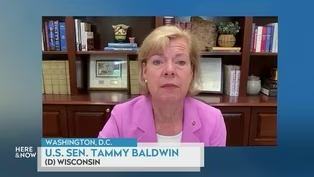
Wisconsin Senators Ron Johnson and Tammy Baldwin reacted with support and skepticism.
>> As no matter how many votes we had to try and limit the president's power here, the American people have a say in this.
And I would say the American people, by and large, overwhelmingly the majority did not want President Trump to introduce the type of ground troops to completely defeat the Revolutionary Guard and the brutal dictators of Iran.
So here we are again.
I don't know what's in the memorandum of understanding.
We can always go back in.
The minute they make a move toward the nuclear sites, we can bomb them again.
We can try and work with them.
>> He needs to show the American people what is in this agreement, what our plan is to reach a real long term peace deal and explain how any of us are better off now compared to three and a half months ago.
Until a long term peace agreement is signed and sealed, and any nuclear agreement is delivered to Congress, I'm going to continue to do my job and force the Senate to vote to stop this war.
>> At the start of the war in Iran, we checked in with two Iranians who have lived and worked in Wisconsin for years but maintain close ties with their country.
The shock and awe of those early days was, of course, distressing and terrifying.
This week we checked back in with them to see what they think of the end of hostilities.
With a signed agreement between the U.S.
and Iran.
They both said they don't trust the Iranian regime to uphold agreements, and it must now be up to the civilian population in Iran to take back their country, no matter the odds.
Here are Ali Soltani and Zara Fakhri speaking about the Islamic Revolutionary Guard Corps and the regime.
In the face of the agreement with the U.S.
>> Iranians are in constant war while the IRGC is in power and the IRGC has repeatedly failed in any agreement with any country, with any group or community.
So that's why for Iranians, there is no longer hope or believing in any agreements that is done by these people.
We do not trust them.
We do not believe in them.
And we are not seeing any progress because for 47 years they have shown themselves.
So we also do not believe that it's a real agreement.
>> What we have to realize is that this cessation of hostilities, peace talks, whatever you want to call it, it's only possible with freedom for the Iranian people.
The nature of this regime has not changed.
Whether what they're doing is the result of basically military pressure.
So they welcome war.
They want war, they want crisis.
They want these kind of things to suppress the internal aspirations of the Iranian people.
So they're there because they're forced to.
The real fight is actually between the Iranian people and this regime within the last four days, since Saturday until Tuesday, they have executed 61 people, 61 prisoners.
That is one every three hours.
So they're very scared of the people and their uprising and their organized resistance.
>> It was a roller coaster for all of us because it's not acceptable to see your country being bombed or being under UN strikes.
But at the same time, the wildest thing that I've heard from many Iranians is that we are even okay with that.
If the day after bombing or strikes, we see free Iran and there is no IRGC and they toppled.
So that was the only thing that we were looking for.
Although we were all full of fear, we were all worried about our family members, our relatives.
>> You cannot overthrow a regime with bombing, okay?
From air, it's impossible, especially a regime that's ideologically driven.
You need the people inside Iran, the organized opposition that we have, they know every way there is.
They know the people inside Iran.
They know who is responsible.
>> Right now.
I think after all of the things and complications that has happened, they got even more confident because they faced the war with Israel and United States.
I cannot call any other country who is more powerful in military services or powers in this kind of matter.
But now they say that we won't over Israel, we won't over United States.
So I think the worst thing that I could see after the war was seeing them getting more confident.
That's the worst thing that I could see.
>> You know, the last four uprisings in Iran, one in I think was 2019 was for the gas prices that went up in 2018.
I think it was price of chicken that went up in 2026.
The last one that we saw it was in started from Bazaar because of the price of the dollar just increased a lot.
So this regime is incapable of solving the Iranian people's problems.
So as long as the structure is corrupt and you cannot address the basic needs of the Iranian people, the these uprisings will happen.
It's a matter of time.
>> We are full of hope.
>> It has been for 47 years.
I mean, not the generation at the time that they were protesting or they were fighting against IRGC the second generation of that.
And I know the third generation are right now joining us everywhere, even in social media, TikTok and Instagram.
So I don't see that anyone has lost their hope.
We we are full of hope because we we read the history.
There is no dictatorship that they can last long.
>> The people of Iran need to rise up themselves and.
And they do have organized resistance.
They need to basically get the international community's recognition.
That's what we need.
We don't need any help money.
We don't need any soldiers or boots on the ground from foreign powers.
We need their recognition and their help to basically help the Iranian people.
>> The first priority for all Iranians right now is to be the voice of Iranian people inside Iran, and also showing the whole world that what is real Iranians and how we are separating ourselves from IRGC.
>> The economic engine of the state is looking at a whopping county government budget shortfall.
Milwaukee County leaders project a $50 million deficit next year, and a nearly $170 million shortfall in five years.
That's if measures to cut costs aren't taken.
What is happening?
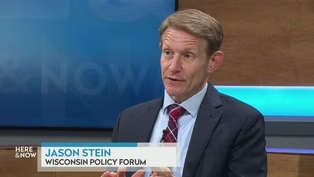
We turn to Jason Stein, president of the Wisconsin Policy Forum, and thanks for being here.
>> My pleasure.
Thank you.
>> So what is happening?
I thought that the shared rev deal and new county sales tax was supposed to make things okay.
>> Right.
So you're referring to a 2023 law that provided both new sales tax authority to the county, as well as additional state aid.
And those were helpful.
I mean, the sales tax revenue is going to be nearly $90 million projected for 2027.
So without that money, that that $50 million shortfall is even larger.
But at the same time, that deal also imposed new costs on the county to, you know, shift to the state pension system, which is a good long term fix but is challenging in the short term.
And then additional law enforcement costs and other costs.
So it was very helpful, but it didn't change the fact that the county has a structural imbalance between how fast its revenues are growing and how fast its expenses are growing.
And you see that showing up in this this budget shortfall.
>> So I understand that 75% of the county's budget is mandated state services, some of which you just spoke to, including court operation and highway patrols.
So what goes the quality of life?
Things like parks and pools.
>> Absolutely.
And, you know, there are a number of also discretionary challenges that the county has.
The county also has its transit program, which is facing a big challenge in 2027 because it's finally exhausted.
The federal pandemic aid, which stuck around a little bit longer for transit operations than other parts of government.
So that's a challenge.
It has a county courthouse that it needs to replace.
That's nearly a half $1 billion project.
And then you talk about its parks, something like that amount in deferred maintenance to its parks system.
So it has a lot of generational challenges that are still pressing it pretty strongly.
>> So how does the county stave off these deficits?
>> I mean, I think when you have a challenge of this size, you're going to have to look on the cost side and the revenue side.
So, I mean, the challenge on the cost side is that the county has really had 20 years now of making, you know, cuts and trims and other things.
But, you know, they're going to have to look in transit.
They're going to have to look across their, their system to try and find some savings.
And then at the same time, they're probably going to have to find revenues, whether that's it's from increasing their vehicle registration fee, whatever it happens to be that they can do because there aren't a lot of levers they can pull.
>> Should or could the state do more?
>> I mean, the state in the current budget, it should be said, did a lot for the county in that the state put forward funds for patrolling the highways in Milwaukee County.
So that was a big financial help.
Governor Evers, with one of his partial vetoes, also lowered the cost of.
To counties of housing juvenile offenders in a state prison for youth, which.
That helped Milwaukee County more than any other county.
So there was assistance there.
But you'll you'll you'll certainly hear elected officials from the county going to the state again over the next year.
>> How vexing is this perennial problem, especially for the county executive now running for governor?
>> I mean, it's every county executive faces this.
I mean, another county executive who became governor, Scott Walker, you know, faced the same shortfalls in some of these capital challenges have built up over a period of time.
That goes back to the 2000, when Walker was Milwaukee County executive.
So it's certainly a challenge.
I think one of the things that I'm sure the county executive will will ask for, you know, elected officials to ask for is freedom from the state limits on county property taxes.
So more flexibility to raise local revenues to deal with these problems.
But of course, the state has been reluctant to give that flexibility.
>> So I trust that Milwaukee County is not the only county that is facing these kinds of budget crunches.
>> No, that's certainly the case.
I think it is worth noting, though, that Milwaukee County, particularly in the city of Milwaukee, has some of the poorest residents.
So any county or any city that has a transit system, for example, is facing that same problem with the loss of federal revenue, ridership and ridership revenue being down and the cost being up.
But in Milwaukee County, it has a particular pinch and resonance because you really have people that are relying on that transit system, low income people to get to a job, to get to a doctor's appointment, to get to the grocery store.
And so the impact is magnified, I think, over many places in Wisconsin.
>> All right.
Jason Stein, thank you very much.
>> My pleasure.
Thank you.
>> Campaigns for governor ahead of the August primary.
Head into high gear with some Democrats in the field getting a boost after the party's state convention.
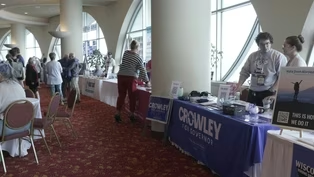
A straw poll of party activists put Lieutenant Governor Sarah Rodriguez on top with state Representative Francesca Hong in second and state Senator Kelda Roys coming in third.
Here's a glimpse of candidates speeches at the convention.
>> Does the job I'm asking you for starts with showing up and then standing up.
Here's what I hear out there.
Our neighbors are scared.
They are angry because even if they are doing everything right, they cannot make ends meet.
They work hard and want a paycheck that covers the rent or mortgage before it's gone.
They need a health insurance premium that they can afford.
So when they get sick, they have the care that they need.
They need public schools that are fully funded for their kids so they don't have to go to referendum.
>> We've seen this before in Wisconsin.
Scott Walker ran this con for eight years.
Divide and conquer got the public sector hollow out schools, attack workers and treat government like the enemy.
When Tony Evers asked me to serve as his top cabinet official, we inherited a mess.
Depleted reserves, structural deficits, teachers, state employees, and working people who had been treated like a punching bag for eight years.
So we rolled up our sleeves and we got to work.
We constructed responsible budgets that returned us to Wisconsin values.
>> I do want to be honest, because as I travel, people always ask me, David, can a Black candidate become governor?
Hell yeah.
If it's a candidate with a track record of delivering results and winning and not just talking about them?
Yes.
If it's a candidate that has a plan that's built on proven public policy, not whatever the latest poll says, it's popular, then yes, the answer is simple, y'all.
Yes.
And I am that candidate.
I've built a strong coalition in the state's largest county while earning support from our rural, suburban urban communities alike.
>> I am running for governor to raise wages, lower costs, deliver great public schools, and protect our freedoms from this authoritarian regime.
We will lower the cost of the biggest ticket items, from housing to health care, child care to utilities.
I don't just have bullet points, I have bills.
I don't just have social posts, I have plans.
And we know this is possible because we've done it before, right?
As the executive director of NARAL Pro-Choice Wisconsin, I helped pass the first pro-choice law in 30 years through an anti-choice Republican Assembly.
>> We have been failed by the status quo for far too long.
And it's not just enough to be anti-Trump.
It's not enough to just be a Democrat.
If you're going to cave to corporate interests, we need a governor who rejects the Washington way of rampant corruption and corporate running for governor to do things the Wisconsin way.
That means taxing the rich.
That means freezing the rates.
That means keeping our community safe.
And in the AI schemes that rig the system, fully funding our public schools, passing universal child care, and delivering health care to every single person in this state, and standing up to those monopolies that continue to bankrupt our family farms and raise our utility bills.
I am asking for your support in August, and I'm asking you to organize with me all the way through November to take back with me.
>> I am running on a platform of permanent affordability, not as a slogan.
Not as a slogan, but as a practice.
I am the only candidate in this race who has called for a moratorium on the construction of AI data centers.
I will not meekly accept the sellout of Wisconsin to millionaires, billionaires and big tech.
I am the only candidate in this race with a plan for free childcare.
I am the only candidate in this race who has even considered what AI will do, what it means for our workers and our civil rights.
>> The first thing I had to do as Secretary of Economic Development was clean up Foxconn.
No problem.
I had three children under the age of two.
I know how to clean up a mess.
So I cleaned up Donald Trump and Scott Walker's mess and saved the state and Wisconsinites billions of dollars.
And then Covid hit.
Covid hit.
And let me tell you, that's not a great time to be in charge of the state's economy.
But we rolled up our sleeves and we got to work.
>> On the Republican side, current seventh congressional U.S.
representative Tom Tiffany got his party's endorsement in his run for governor at their convention.
>> We're going to take a shovel to waste and fraud.
We're going to root out corruption.
And we're going to bring common sense back to Madison.
Because I refuse to accept failure.
I refuse to accept decline, and I refuse to see the state of Wisconsin fall behind.
>> Republican Andy Manske is also running.
In other news, the Ho-Chunk nation will receive 165 acres of their ancestral homelands in a land transfer.
The effort was funded by the Dane County Conservation Fund in collaboration with the county's Land and Water Department.
Here and now, reporter Erika Ayisi went to the site to hear how the Ho-Chunk will use the property.
This report is in collaboration with Icty, formerly Indian Country, today.
>> Every plant is a resource, right?
They say everything our Mother Earth gives us.
He goes like, that is a form of medicine.
You just have to find out what it is so you can smell that.
historic preservation officer for the Ho-Chunk nation, says plants can soothe sores on the body.
>> It allows you to heal a little bit better.
So it's a different form of medicine.
mounds, and waterways in the Lower Mud Lake Natural Resource Area are a part of 165 acres of property returned to Ho-Chunk nation from Dane County.
Quackenbush says the land acquisition is an opportunity for the public to learn.
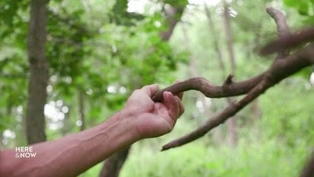
>> So the milkweed itself, we call it Marquette.
You just during this time of year, these heads over here, while they're really young, you pick that and it doesn't hurt the plant at all.
Once you gain the knowledge and use of it there, that's something that we tend to pass on from generation to generation.
The plants.
>> So nearly $6.5 million from the Dane County Conservation Fund was used to purchase a private property south of Babcock County Park, including significant frontage along Yahara River Lower Mud Lake and Lake Waubesa.
Dane County will place it in a conservation easement in partnership with Groundswell Conservancy, a nonprofit environmental organization, to permanently prohibit development, preserve public access and protect the land's cultural significance.
>> Ho-Chunk nation will own and manage the land, steward the land in perpetuity.
>> Quackenbush says.
The Ho-Chunk are the land's original caretakers.
>> We're the only tribe that has the ability to speak confidently about the.
We were the first and original people from this region right here.
>> When you say ancestral territories, we're Ho-Chunk always here.
>> We have beautiful stories that talks about how we adapted through time from living in a place of refuge and moving back into these first places as that glacier began to recede.
>> He says.
Their oral history talks about their cultural and environmental adaptation.
As Ho-Chunk people moved through the region for thousands of years.
>> That place of refuge that we referred to, today's society calls Driftless Area.
>> He says.
Their indigenous language mentions red banks of the past that are still evident in Wisconsin today.
>> We say Moogasuc in our language.
It places you exactly where that location is.
These red banks that are associated with this ancestral place of origin.
>> According to Quackenbush, the Ho-Chunk nation will be solely responsible for costs including property taxes and maintenance of the land.
With insight from the conservancy that includes six archeological sites and 22 ancient burial mounds.
>> There's a mound system that rises right straight through it that's nothing more than a large mortuary site.
It's like walking across a burial system.
For modern people out there, there's some respect that needs to be instilled in that.
>> According to archeologists, there's at recorded archeological sites in the Dunn Township part of Dane County.
But the sites on the 165 acres donated to Ho-Chunk were lost in a series of treaties between the Ho-Chunk and the federal government during the 1800s, long before Wisconsin was an established state.
This began an era of forced removals for Ho-Chunk, the original caretakers of this land and its waters.
>> By captions in time in the 1800s, primarily where a lot of land was ceded because there was forced removals.
>> Jon Greendeer, president of the Ho-Chunk nation, says the treaties forced the tribe to relocate across the Midwest, but they returned to Wisconsin.
>> We were able to not only survive in some of those regions, we were also able to thrive and repopulate.
>> Ho-Chunk became an official nation in 1963, and today has about 8000 enrolled members.
Greendeer says the land acquisition is about regaining their cultural footprint on their ancestral homelands.
>> For the Ho-Chunk nation, we never really believed in land ownership.
We believed that the land was there for us to use as we need it.
>> Considering that there's a conservation easement between Dane County and Groundswell Conservancy, who is on the title in this project.
>> The Ho-Chunk nation is going to be entitled to the project, and it's going to be a part of anything going forward.
If there's any decisions to be made in terms of development in that area.
>> As to the property, Groundswell Conservancy says the group, along with Dane County, will do annual visits to the location.
>> To make sure that the conservation values are being upheld in conjunction with the Ho-Chunk nation.
>> And support Quackenbush in meeting the tribe's goals to preserve the site.
>> What we want is the protection and enhancement of the environmental resources.
for the public to sit and engage and learn.
>> This property is a beautiful educational opportunity unfolding before our eyes.
>> In Madison.
I'm Eric Ayisi for Here and Now and ICT.
>> Finally tonight, in honor of the end of slavery more than 160 years ago, on June 19th, 1865, Governor Tony Evers raised the Juneteenth flag at the state Capitol.
This marked the seventh straight year the flag has flown over the dome.
Juneteenth was declared a federal holiday in 2021 and is recognized and celebrated in 50 states and the District of Columbia.
For more on this and other issues facing Wisconsin, visit our website at PBS wisconsin.org and then click on the news tab.
That's our program for tonight.
I'm Frederica Freyberg.
Have a good weekend.
>> Funding for "Here& Now" is provided by the Focus is provided by the Focus Fund for Journalism and friends of PBS Wisconsin.
 New
NewCandidates for Governor Make Their Case to The Parties
Video has Closed Captions
Clip: S2400 Ep2449 | 5m 45s | Candidates running for governor made their appeals at the annual party conventions. (5m 45s)
 New
NewDane County Returns 165 Acres to the Ho-Chunk Nation
Video has Closed Captions
Clip: S2400 Ep2449 | 5m 55s | The Ho-Chunk Nation will receive 165 acres in a land transfer funded by Dane County. (5m 55s)
 New
NewHere & Now opening for June 19, 2026
Video has Closed Captions
Clip: S2400 Ep2449 | 1m 8s | The introduction to the June 19, 2026 episode of Here & Now. (1m 8s)
 New
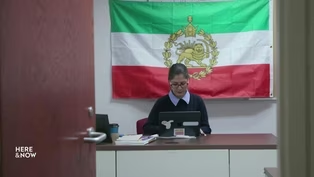
NewIranians in Wisconsin React to US-Iran Peace Negotiations
Video has Closed Captions
Clip: S2400 Ep2449 | 5m 56s | Iranians in Wisconsin discuss the Iranian government in light of announced peace talks. (5m 56s)
 New
NewJason Stein on Budget Headwinds Facing Milwaukee
Video has Closed Captions
Clip: S2400 Ep2449 | 5m 18s | Jason Stein on a $50 million dollar deficit in one year in the Milwaukee County budget. (5m 18s)
 New
NewWisconsin Senators on The Memorandum of Understanding
Video has Closed Captions
Clip: S2400 Ep2449 | 1m 33s | Tammy Baldwin and Ron Johnson on the announced peace talks to end the Iran war. (1m 33s)
Providing Support for PBS.org
Learn Moreabout PBS online sponsorship New Episode
- News and Public Affairs

Top journalists deliver compelling original analysis of the hour's headlines.
 New Episode
- News and Public Affairs

Today's top journalists discuss Washington's current political events and public affairs.


 New Episode
 New Episode
 New Episode


 New Episode
 New Episode
 New Episode
Support for PBS provided by:
Here and Now is a local public television program presented by PBS Wisconsin